85. Organizational Partnering Model

1 July 2026
How can I do business with other organizations?

Key Definitions

Interorganizational relations are the connections that an organization has with other parties in the industry value chain, such as suppliers, contractors, distributors, buyers, and competitors, but also with other contextual actors such as unions, governments, universities, and the media.

In the value chain, relations have traditionally been characterized as transactional (market-based) or controlled (hierarchy-based) – the actors were either independent of each other (at arm’s length) or dependent on each other (fully integrated). Between these two extremes lay cooperative relationships (partnership-based), whereby the two parties are interdependent.

Conceptual Model

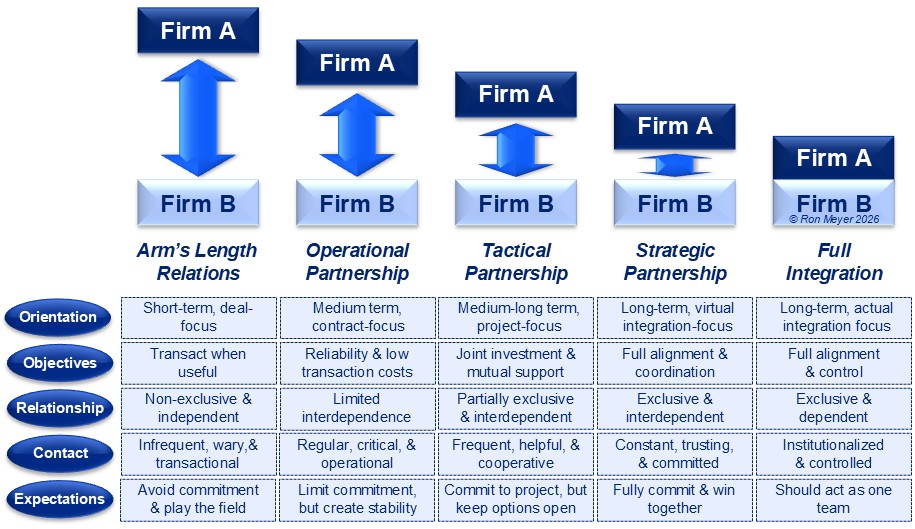
The Organizational Partnering Model is a framework outlining three types of partnering, between the two opposite poles of arm’s length relations and full integration. Distinguishing these three is important as partnering is often seen as only one option instead of three. In this model, each of the five types of organizational relationships is explained, making it a useful framework to determine the most appropriate way to do business with other organizations.


Key Elements

The five organizational relationship types are the following:

  1. Arm’s Length Relations. The most common relationship is the transactional one, where organizations buy or sell products and/or services with no strings attached. This approach is most appropriate when transaction costs are low, switching is easy, and there is little need for a stable, reliable relationship. Organizations can then shop around for the best deal, without getting locked into one party and becoming more dependent. The relationship is fundamentally competitive, as conditions are determined based on negotiating power.
  2. Operational Partnership. Where costs associated with each transaction are higher, switching is more difficult and/or costly, and there is a need for a more stable and reliable relationship, organizations can opt to sign contracts covering multiple transactions over a longer period. Such a framework agreement usually fixes prices and conditions to prevent opportunistic behavior. However, such deals are generally time-limited and non-exclusive to avoid lock-in, while the relationship is still largely competitive and negotiated.
  3. Tactical Partnership. Where parties need to jointly invest and support each other to realize a specific common goal, their relationship will need to be tighter, more trusting and long-term. As switching will be more difficult, they will need to be more committed to the joint venture, but at the same time both will want to keep their options open and not become too dependent on the other. Such a relationship is a tactical halfway house between cooperation (winning together) and competition (winning at the expense of the other).
  4. Strategic Partnership. Where both sides become indispensable to each other – either winning together or losing together – they often choose to fully commit to a long-term mutually beneficial relationship. Not only does this require aligning their operations, but they will also need to coordinate their strategies, thereby moving towards virtual integration. This level of cooperation demands a high level of commitment, trust and reciprocal support, which usually can only be maintained in an exclusive or nearly exclusive relationship.
  5. Full Integration. When the level of dependence on each other is high, it can leave one or both sides feeling vulnerable to the other’s underperformance, or even worse, to potential misalignment, conflict and/or self-serving behavior. As partnering is based on voluntary cooperation, the exposed side can feel they have limited power to influence the other side’s behavior. Therefore, they often prefer to take ownership of the other, so they have formal control and can integrate them into the governance structure, thus “enforcing cooperation”.

Key Insights

  • Partnering is found between bachelorship and marriage. Like committed bachelors, organizations can play the field, while keeping suitors at arm’s length and remaining independent, or they can tie the knot, committing to integrating their lives for the long run. Yet, between these two opposites, there is the possibility to build a partnership, balancing the need for self-determination and autonomy with the need for cooperation and stability.
  • Partnering comes in three forms. An operational partnership is a loose form of cooperation, focused on medium-term stability and predictability, almost like dating. A tactical partnership is a tighter form of cooperation around an important joint interest, almost like living apart together. A strategic partnership is a very tight form of cooperation, focused on long-term integration, like living together but without getting formally married.
  • Partnering balances competition & cooperation. Organizations need to be competitive – focused on winning themselves even when it is at the expense of others. Yet they also need to be cooperative – focused on working with others to win together even when it might be at their own expense. The three partnering forms find a different balance between both.
  • Partnering is harder than the extremes. The invisible hand of the market (arm’s length relations) and the visible hand of management (integration) are easier than the continuous handshake, which requires mutual understanding, trust and ongoing coordination.
  • Partnering is a strategic choice. For each organizational relationship in the value chain, all five alternative forms of doing business with each other need to be considered.
Subscribe to our monthly Management Model

Do you want to be notified of our monthly Management Model? Please fill in your email address here.

July 2026
Organizational Partnering Model

June 2026
Feedback Flavors Framework

May 2026
Humanistic Organization

April 2026
Resource Base Dial

March 2026
Personal System Map

February 2026
Five Company-Centric Forces

January 2026
Strategic Assignment Matrix

December 2025
New Learning Curve

November 2025
Organizational Diamond

Oktober 2025
5T SMART Plan

September 2025
Conversation Elevator

August 2025
Innovation Arena

July 2025
Integration Zippers

June 2025
Courageous Core Model

May 2025
Five Phases of Change

April 2025
Frictionless Flow Framework

March 2025
Interaction Drivers

February 2025
Innovation Sins & Virtues

January 2025
Top Line Growth Pie

December 2024
Sustainability Maturity Ladder

November 2024
Self-Centered Thinking Traps

October 2024
Corporate Synergy Typology

September 2024
Guiding STAR Matrix

August 2024
Hunting & Farming Typology

July 2024
Wicked Problem Scorecard

June 2024
Time Management Funnel

May 2024
Digitalization Staircase

April 2024
Leadership Circle Map

March 2024
MOVING Mission Framework

February 2024
BOLD Vision Framework

January 2024
Duty of Care Feedback Model

December 2023
Best Practice Sharing Modes

November 2023
Stakeholder Stance Map

October 2023
Status Snakes & Ladders

September 2023
Customer-Centricity Circle

August 2023
Activity System Dial

July 2023
New Pyramid Principle

June 2023  
Cultural Fabric Model

May 2023       
Corporate Strategy Framework

April 2023  
Ambition Radar Screen

March 2023
Resistance to Change Typology

February 2023   
5I Innovation Pipeline

January 2023     
Thinking Directions Framework

December 2022      
Corporate Management Styles

November 2022     
Strategic Action Model 

October 2022
Psychological Safety Compass

September 2022
The Tree of Power    

August 2022
Value Proposition Dial

July 2022
Sustainable You Model

June 2022
Change Manager’s Toolbox

May 2022
Corporate Value Creation Model

April 2022
Organizational System Map

March 2022
Creativity X-Factor

February 2022
Strategic Alignment Model

January 2022
Market System Map

December 2021
Team Building Cycle

November 2021
Disciplined Dialogue Model

Oktober 2021
Strategy Hourglass

September 2021
Powerhouse Framework

August 2021
Fruits & Nuts Matrix

July 2021
Everest Model of Change

June 2021
Followership Cycle

May 2021
Knowledge Sharing Bridges

April 2021
Innovation Box

March 2021
Empowerment Cycle

February 2021
Digital Distribution Model Dial

January 2021
Digital Product Model Dial

December 2020
4C Leadership Levers

November 2020
Rebound Model of Resilience

October 2020
Strategic Bets Framework

September 2020
Storytelling Scripts

August 2020
7I Roles of the Corporate Center

July 2020
Strategy Development Cycle

June 2020
Rising Star Framework

May 2020
The Control Panel

April 2020
Strategic Agility Model

March 2020
Leadership Fairness Framework

February 2020
11C Synergy Model

January 2020
Competition Tornado

December 2019
Confidence Quotient

November 2019
House of Engagement

October 2019
Revenue Model Framework

September 2019
Interaction Pressure Gauge

August 2019
Digital Platform Map

July 2019
Mind the Gap Model


Double-click to edit button text. crossarrow-leftcross-circle