
In cybernetics (the study of control systems), feedforward is the initial assignment given to a system or person to direct its behavior, while feedback is the information looped back to that system/person with the goal of correcting or confirming its course of action. In other words, the purpose of feedback is to steer the other in the intended direction.
Unfortunately, in common usage, “feedback” has come to mean any type of comment that people make to someone else. “Can I give you some feedback?” is usually followed by an assessment, complaint, frustration and/or verdict. However, expressing a judgment without the intention of steering the other’s behavior isn’t feedback, but merely stating one’s opinion.
The Feedback Flavors Framework is a model outlining ten categories of responses that people can give to the behavior of others, of which four “flavors” qualify as highly effective feedback and four as moderately impactful. The main purpose of the model is to help distinguish between judgment and effective feedback. A response is a judgment if it is intended to convey the sender’s evaluation. It is only effective feedback if the response is tailored to influence the receiver’s behavior. Stated simply, judgment is “what I would like to say”, while feedback is “what the other needs to hear”. So, giving effective feedback requires the sender to move beyond merely expressing an opinion, to consider how to get the receiver to move in a particular direction. The framework then suggests four highly effective feedback flavors (in darker blue) and four moderately effective ones (in lighter blue). Two are usually ineffective.
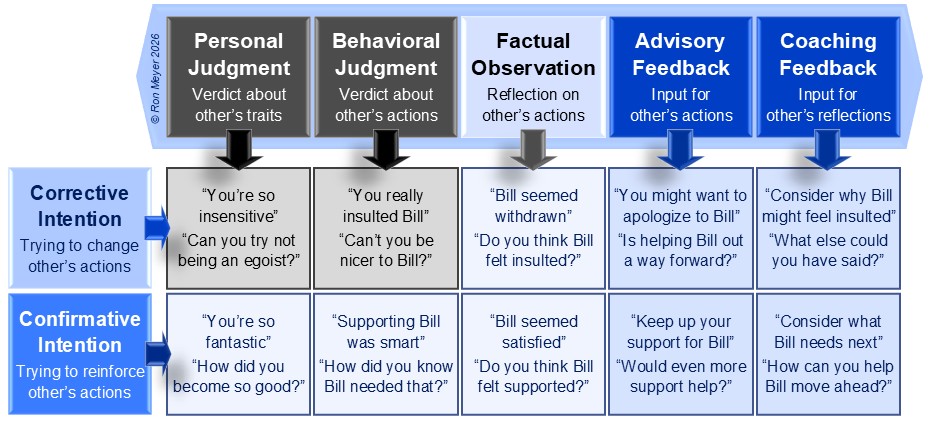
The two opposite reasons for wanting to give feedback (on the vertical axis) are:
The five main categories of responses (along the horizontal axis) are the following: