
Organizations are groups of people working together to achieve a shared goal. To realize their common objective, they split the required tasks amongst one another and then cooperate to align their activities. This division and subsequent coordination of labor makes specialization possible, leading to increased expertise (higher quality) and economies-of-scale (lower cost).
There are many types of organizations, but a more limited number of organizational paradigms – lenses through which we understand what organizations are and how they function. For centuries, the most dominant paradigm has been to see organizations as a type of machine, with people as human resources slotted into the machine (mechanistic organization paradigm).
The Humanistic Organization Paradigm is a cognitive framework for understanding what organizations are and how they function. To clarify its fundamental tenets, the figure below contrasts the humanistic perspective with the core assumptions underpinning the mechanistic organization paradigm. While the latter sees people as human resources that can be employed to enable the machine to work more effectively, the humanistic organization paradigm sees organizations as arrangements that enable people to work more effectively. The mechanistic approach is focused on controlling everything, including people, while the humanistic approach aims at enabling people. Using this paradigm more consistently can have a far-reaching impact on how people organize, while as a practical tool it can be used as checklist to search for ways to energize people and improve organizational effectiveness.
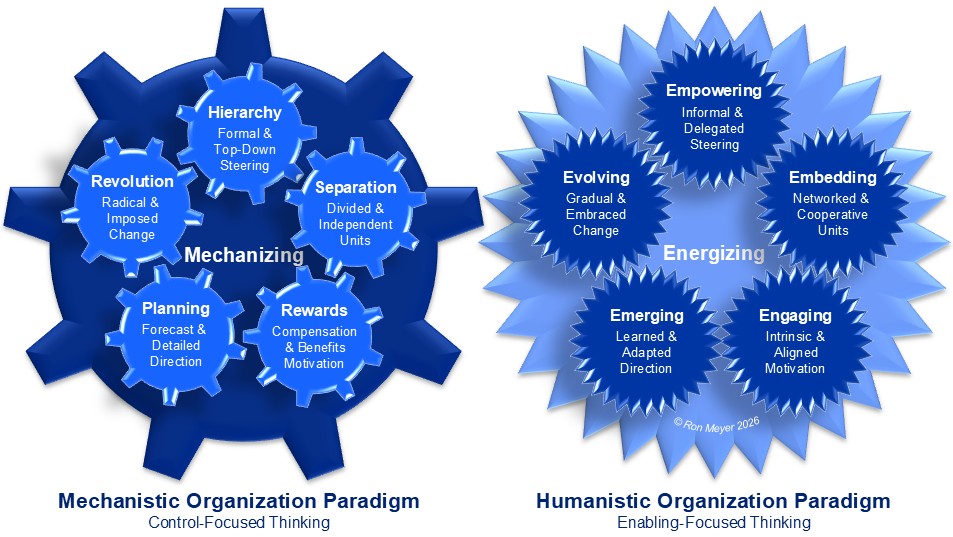
The five main differences between the paradigms are the following: