81. Personal System Map

1 March 2026
Which elements make up who I am, and can I develop these?

Key Definitions

Each person is a complex system of interconnected parts, that defies a simple division into independent building blocks. Still, it can be analytically useful to unravel people into a few key elements, to understand which parts are more susceptible to development than others.

For centuries, philosophers, scientists and amateur psychologists have debated whether people are largely shaped by nature (genes) or nurture (learning), and to what extent their characteristics are stable or can change over time. However, it is safe to say that at least some aspects of a personal system have been learnt and can be developed further moving forward.

Conceptual Model

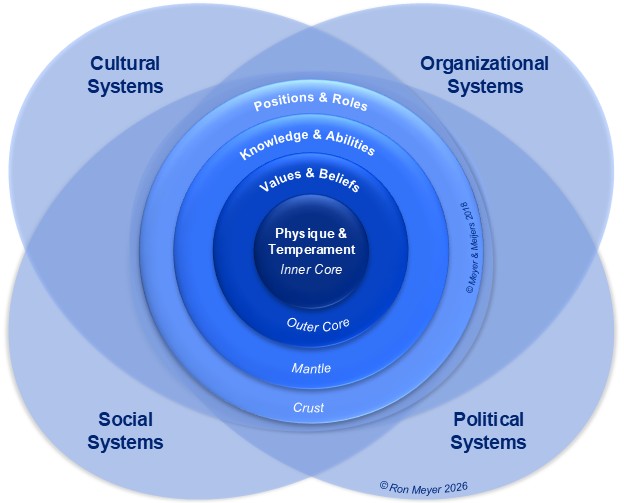
The Personal System Map is an analytical framework (building on Meyer & Meijers, 2018) for understanding which elements make up who a person is, and which will be easier to develop over time. Using the metaphor of a planet, the model suggests that each person consists of four layers, with each deeper one being less adaptable. At the same time, each person is embedded in four external systems that, as four linked types of atmosphere, influence the planet from the outside-in. The message is that people are partially shaped by the systems (also called institutions) they operate in and that the most effective way to develop is to also change from the outside-in – changing positions and roles first and then working inwards.
Key Elements

The four layers making up each individual are the following:

  1. Physique & Temperament. Each person’s most stable aspect is their physical body (their hardware) and their fundamental personality traits (their operating system). They might gain some weight, but they won’t get taller, while their “big five personality traits” can shift a bit over the years, but not change radically. Both are strongly influenced by genes.
  2. Values & Beliefs. On this operating system people run a few basic programs that define what to them is of importance (their values) and what is obviously true (their beliefs). These principles form the cognitive filter through which they perceive the world. While rooted in their temperament, both were shaped, and can still be influenced, by external factors.
  3. Knowledge & Abilities. On top of the basic programs, they collect a lot of information and insights, both articulated and tacit (their knowledge), while also developing app-like skills and routines that allow them to act (their abilities). These are easier to learn, influenced by external factors, but need to fit within the frame of a person’s underlying values and beliefs.
  4. Positions & Roles. Using one’s knowledge and abilities, a person can fulfill formal positions in organizations and play informal roles in a variety of external systems. This is the easiest aspect of a person to change, as one can switch jobs (“I was a manager, now I’m a professor”) and/or pick up new roles (“I’m now a stepfather”).

Positions and roles are part of a personal system (you are your position/role), but at the same time they are also part of one of these external systems:

  1. Cultural Systems. A person can belong to various groups who share unwritten behavioral norms, based on common values and beliefs, and expressed in shared customs, symbols and stories. You can be part of a national, professional or even pop culture (“I’m a Swiftie”).
  2. Organizational Systems. A person can belong to various organizations, which are people structurally cooperating to achieve joint goals. You can work at a business or non-profit organization, but you can also be a member of a sports club or church (“I’m a Catholic”).
  • Political Systems. A person can also belong to a web of stakeholders, each with their own power and interests, who interact with each other to decide on important issues. You can participate in governmental politics, but also in networks and associations (“I’m a lobbyist”).
  1. Social Systems. A person can also belong to various social groups, that share a sense of relatedness, closeness, attachment and loyalty, such as families, clans, tribes, fraternities and communities (“I’m a Meyer”).

Key Insights

  • People consist of four levels. Each person can be understood as made up of four levels: an inner core of physique and temperament (“I am tall and extrovert”), an outer core of values and beliefs (“I am liberal and democratic”), a mantel of knowledge and abilities (“I am a chess player”) and a crust of positions and roles (“I am a teacher and husband”).
  • People are embedded in four external systems. Each person’s positions and roles are part of four overlapping external types of systems: cultural, organizational, political and social systems. People can be embedded in hundreds of different systems.
  • People are shaped through nature and nurture. From birth, people develop from the inside-out based on their physique and temperament (nature) and simultaneously from the outside-in, based on the positions and roles that they take (nurture). The result is a mix.
  • People are difficult to change on the inside. As people mature, the deeper layers become gradually more fixed. Their physique and temperament were already hardly changeable, but increasingly their values and beliefs become engrained, while their knowledge and abilities become entrenched and more difficult to adapt or expand.
  • People can develop best from the outside-in. By changing positions and roles, people often find it easier to acquire new knowledge and abilities, and even shift/broaden their values and beliefs. Hence, personal development often works best from the outside-in.
Subscribe to our monthly Management Model

Do you want to be notified of our monthly Management Model? Please fill in your email address here.

March 2026
Personal System Map

February 2026
Five Company-Centric Forces

January 2026
Strategic Assignment Matrix

December 2025
New Learning Curve

November 2025
Organizational Diamond

Oktober 2025
5T SMART Plan

September 2025
Conversation Elevator

August 2025
Innovation Arena

July 2025
Integration Zippers

June 2025
Courageous Core Model

May 2025
Five Phases of Change

April 2025
Frictionless Flow Framework

March 2025
Interaction Drivers

February 2025
Innovation Sins & Virtues

January 2025
Top Line Growth Pie

December 2024
Sustainability Maturity Ladder

November 2024
Self-Centered Thinking Traps

October 2024
Corporate Synergy Typology

September 2024
Guiding STAR Matrix

August 2024
Hunting & Farming Typology

July 2024
Wicked Problem Scorecard

June 2024
Time Management Funnel

May 2024
Digitalization Staircase

April 2024
Leadership Circle Map

March 2024
MOVING Mission Framework

February 2024
BOLD Vision Framework

January 2024
Duty of Care Feedback Model

December 2023
Best Practice Sharing Modes

November 2023
Stakeholder Stance Map

October 2023
Status Snakes & Ladders

September 2023
Customer-Centricity Circle

August 2023
Activity System Dial

July 2023
New Pyramid Principle

June 2023  
Cultural Fabric Model

May 2023       
Corporate Strategy Framework

April 2023  
Ambition Radar Screen

March 2023
Resistance to Change Typology

February 2023   
5I Innovation Pipeline

January 2023     
Thinking Directions Framework

December 2022      
Corporate Management Styles

November 2022     
Strategic Action Model 

October 2022
Psychological Safety Compass

September 2022
The Tree of Power    

August 2022
Value Proposition Dial

July 2022
Sustainable You Model

June 2022
Change Manager’s Toolbox

May 2022
Corporate Value Creation Model

April 2022
Organizational System Map

March 2022
Creativity X-Factor

February 2022
Strategic Alignment Model

January 2022
Market System Map

December 2021
Team Building Cycle

November 2021
Disciplined Dialogue Model

Oktober 2021
Strategy Hourglass

September 2021
Powerhouse Framework

August 2021
Fruits & Nuts Matrix

July 2021
Everest Model of Change

June 2021
Followership Cycle

May 2021
Knowledge Sharing Bridges

April 2021
Innovation Box

March 2021
Empowerment Cycle

February 2021
Digital Distribution Model Dial

January 2021
Digital Product Model Dial

December 2020
4C Leadership Levers

November 2020
Rebound Model of Resilience

October 2020
Strategic Bets Framework

September 2020
Storytelling Scripts

August 2020
7I Roles of the Corporate Center

July 2020
Strategy Development Cycle

June 2020
Rising Star Framework

May 2020
The Control Panel

April 2020
Strategic Agility Model

March 2020
Leadership Fairness Framework

February 2020
11C Synergy Model

January 2020
Competition Tornado

December 2019
Confidence Quotient

November 2019
House of Engagement

October 2019
Revenue Model Framework

September 2019
Interaction Pressure Gauge

August 2019
Digital Platform Map

July 2019
Mind the Gap Model


Double-click to edit button text. crossarrow-leftcross-circle