80. Five Company-Centric Forces

1 February 2026
Which factors are making my organization more inward-oriented?

Key Definitions

When it comes to their culture and behaviors, organizations can be more outward-oriented, focused on responding to the demands in their external environment, or more inward-oriented, concentrated on dealing with the complexities of their internal environment.

For companies, the ultimate form of outward-orientation is customer-centricity – placing the external customer at the center of everything done internally. The opposite can be called company-centricity, whereby people in the organization pay little attention to the outside world but direct their time and energy at coping with internal processes, interests and interactions.

Conceptual Model

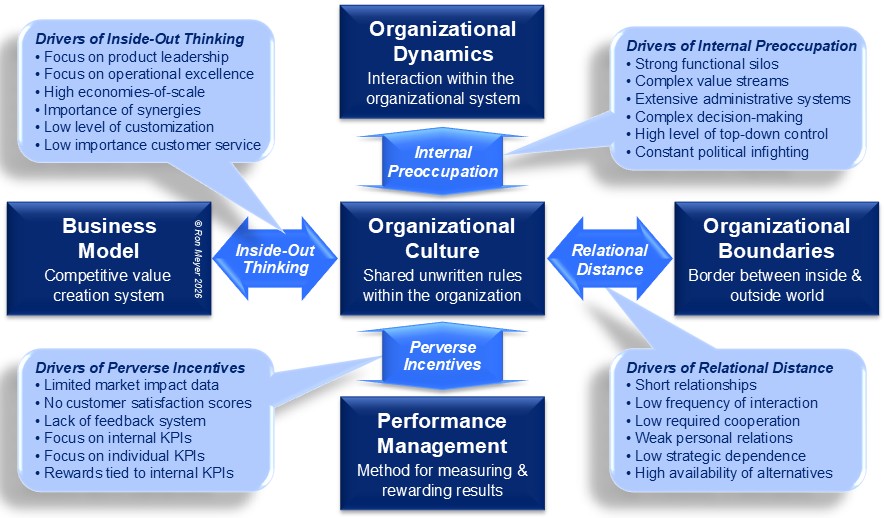
The Five Company-Centric Forces model is an analytical framework for understanding the factors pushing organizations towards inward-orientation. This model is an explicit homage to Porter’s Five Competitive Forces model (1979), that outlined the five external challenges that companies need to contend with to be successful. The Five Company-Centric Forces model outlines the five internal challenges facing companies that draw them towards self-involved inward-orientation, thereby undermining these organizations’ focus on competing externally. The model can be used to uncover the specific drivers of company-centricity in an organization, as a first diagnostic step before taking initiatives to enhance outward-orientation.


Key Elements

The five company-centric forces are the following:

  1. Organizational Culture. At the center of the model is an inward-oriented culture, that values organizational, departmental or even individual views and interests above those of the customer. Like an ego-centric person, company-centric people believe their worldview is the correct one and they know what good looks like. Dealing with each other is also seen as more important than dealing with customers. Once this culture of self-involvement takes root, it becomes self-perpetuating and can be further strengthened by the other four forces.
  2. Business Model. The type of business model chosen can influence how much outward-orientation people believe is necessary. Companies competing on personalization and customer service need to think outside-in, while competing on product leadership, operational excellence, economies-of-scale and capturing synergies push people to think inside-out and concentrate on internal processes. The more the inside-out thinkers capture attention and can claim success, the more a culture is nudged towards inward-orientation.
  3. Organizational Boundaries. Companies often create strong organizational boundaries by keeping their distance from customers. They interact and cooperate infrequently, and avoid personal and long-term relationships, either because they don’t want to, or don’t have to. Keeping customers at arm’s length is generally easier where dependency on customers is low and there are plenty of alternatives. Yet, distance invariably leads to less understanding of, and interest in, customers, thereby reinforcing an inward-oriented culture.
  4. Organizational Dynamics. Companies can also become intensely preoccupied with their own processes and procedures, which shows up in extensive meeting schedules and reporting systems. Strong silos are by nature inward-oriented, but if they need to coordinate because of complex value streams, procedures and meetings proliferate. Self-involvement is further strengthened by complicated decision-making, political games and top-down controls. When employees are busy with each other, they’re not busy with the customer.
  5. Performance Management. Finally, companies often measure and reward the wrong type of results. Instead of tracking market impact data and customer satisfaction feedback, companies often use internal performance indicators, typically at the level of a department or individual, encouraging employees to shortsightedly focus on their own work. Where recognition and rewards are linked to these internal, instead of external, results, a perverse incentive is given to become even more inward-oriented and ignore customer satisfaction.

Key Insights

  • Company-centricity is extensive inward-orientation. Organizations, like people, find it much easier to understand and be busy with themselves, instead of with others. This inward-orientation, as opposed to outward-orientation, comes in various shades of grey, with at its extreme a far-reaching form of self-involvement called company-centricity.
  • Company-centricity is at its heart cultural. Company-centricity is a mindset common to people in an organization, leading to typical behaviors and ways of working. In other words, company-centricity is cultural – unwritten norms based on shared values and beliefs.
  • Company-centricity is driven by five forces. A company-centric culture is self-perpetuating and can be reinforced by four other factors: A business model that emphasizes the importance of inside-out thinking, strict organizational boundaries that lead to relational distance, complex organizational dynamics that trigger internal preoccupation and a performance management approach that creates perverse incentives.
  • Company-centricity grows over time, if unchecked. These five company-centric forces drive a vicious cycle, gradually decreasing awareness of, and interest in, customers.
  • Company-centricity needs to be understood to be countered. The Five Company-Centric Forces model is an analytical framework for understanding the factors causing company-centricity, thereby suggesting places to start building more customer-centricity.
Subscribe to our monthly Management Model

Do you want to be notified of our monthly Management Model? Please fill in your email address here.

February 2026
Five Company-Centric Forces

January 2026
Strategic Assignment Matrix

December 2025
New Learning Curve

November 2025
Organizational Diamond

Oktober 2025
5T SMART Plan

September 2025
Conversation Elevator

August 2025
Innovation Arena

July 2025
Integration Zippers

June 2025
Courageous Core Model

May 2025
Five Phases of Change

April 2025
Frictionless Flow Framework

March 2025
Interaction Drivers

February 2025
Innovation Sins & Virtues

January 2025
Top Line Growth Pie

December 2024
Sustainability Maturity Ladder

November 2024
Self-Centered Thinking Traps

October 2024
Corporate Synergy Typology

September 2024
Guiding STAR Matrix

August 2024
Hunting & Farming Typology

July 2024
Wicked Problem Scorecard

June 2024
Time Management Funnel

May 2024
Digitalization Staircase

April 2024
Leadership Circle Map

March 2024
MOVING Mission Framework

February 2024
BOLD Vision Framework

January 2024
Duty of Care Feedback Model

December 2023
Best Practice Sharing Modes

November 2023
Stakeholder Stance Map

October 2023
Status Snakes & Ladders

September 2023
Customer-Centricity Circle

August 2023
Activity System Dial

July 2023
New Pyramid Principle

June 2023  
Cultural Fabric Model

May 2023       
Corporate Strategy Framework

April 2023  
Ambition Radar Screen

March 2023
Resistance to Change Typology

February 2023   
5I Innovation Pipeline

January 2023     
Thinking Directions Framework

December 2022      
Corporate Management Styles

November 2022     
Strategic Action Model 

October 2022
Psychological Safety Compass

September 2022
The Tree of Power    

August 2022
Value Proposition Dial

July 2022
Sustainable You Model

June 2022
Change Manager’s Toolbox

May 2022
Corporate Value Creation Model

April 2022
Organizational System Map

March 2022
Creativity X-Factor

February 2022
Strategic Alignment Model

January 2022
Market System Map

December 2021
Team Building Cycle

November 2021
Disciplined Dialogue Model

Oktober 2021
Strategy Hourglass

September 2021
Powerhouse Framework

August 2021
Fruits & Nuts Matrix

July 2021
Everest Model of Change

June 2021
Followership Cycle

May 2021
Knowledge Sharing Bridges

April 2021
Innovation Box

March 2021
Empowerment Cycle

February 2021
Digital Distribution Model Dial

January 2021
Digital Product Model Dial

December 2020
4C Leadership Levers

November 2020
Rebound Model of Resilience

October 2020
Strategic Bets Framework

September 2020
Storytelling Scripts

August 2020
7I Roles of the Corporate Center

July 2020
Strategy Development Cycle

June 2020
Rising Star Framework

May 2020
The Control Panel

April 2020
Strategic Agility Model

March 2020
Leadership Fairness Framework

February 2020
11C Synergy Model

January 2020
Competition Tornado

December 2019
Confidence Quotient

November 2019
House of Engagement

October 2019
Revenue Model Framework

September 2019
Interaction Pressure Gauge

August 2019
Digital Platform Map

July 2019
Mind the Gap Model


Double-click to edit button text. crossarrow-leftcross-circle