
An organization is a group of people striving towards a shared goal over a prolonged period of time, who have divided the necessary work between them (differentiation), while coordinating their efforts (integration) to achieve the intended result together (Lawrence and Lorsch, 1967).
An organizational structure is the design used to divide work activities between units and individuals (task allocation), while ensuring that, where necessary, these activities are aligned (task coordination) and they are performed efficiently and effectively (task supervision).
The Organizational Diamond framework offers a simple key for designing even complex organizations. It is based on the premise that when structuring an organization designers need to balance, on the one hand, the advantages of keeping similar value activities together in functional teams (diagonally on the left), with on the other hand the advantages of keeping complementary value activities together in cross-functional value stream teams (diagonally on the right). In other words, every organizational design is fundamentally a balancing act between achieving internal synergies and external responsiveness. When deciding on the most effective structure, this trade-off needs to be considered at various levels of aggregation.
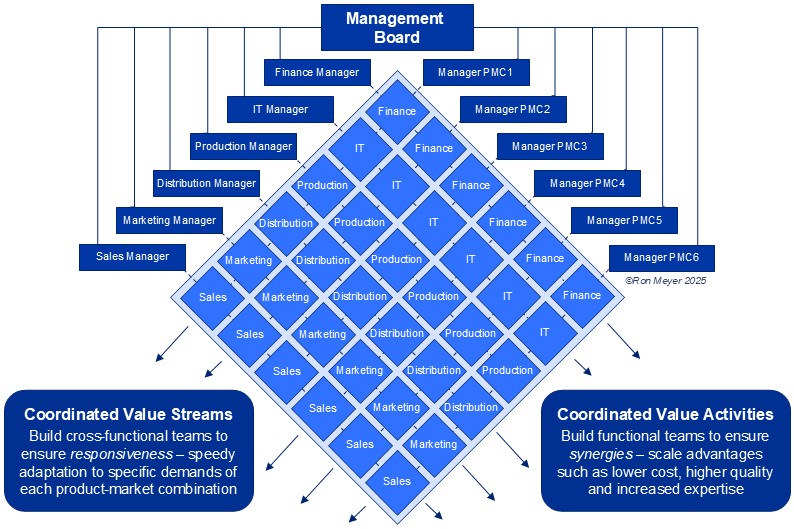
The two fundamental design principles are the following:
The framework then suggests the following organizational design process: