
Learning is the process of acquiring new knowledge (information and insights), capabilities (routines and skills) and attitudes (values and mindset). Competence development is learning directed at making people more effective at achieving results in a particular area.
Learning can be done by individuals, but knowledge, capabilities and attitudes can also be built up in teams and organizations. Where organizations are adept at continuously learning, from their own experience and external sources, they are called learning organizations – they have learnt how to learn and can constantly upgrade and renew their competencies.
The Competence Guilds framework is a model for building a learning organization. It suggests dividing all organizational members into five levels of ability for each strategically important type of competence. Each individual can then progress through each level by learning (arrows on the left). The key to faster organizational learning is that people at a higher level of competence take the responsibility for teaching people at lower levels (arrows on the right), similar to how guilds used to function. Teaching is not made abstract and outsourced to external schools but kept practical and embraced as a crucial leadership task. The experts and masters in each competence area run their guild together and drive organizational learning. As competence levels don’t necessarily coincide with hierarchical levels, anyone can be involved in leading a guild and everyone can be involved in teaching somewhere.
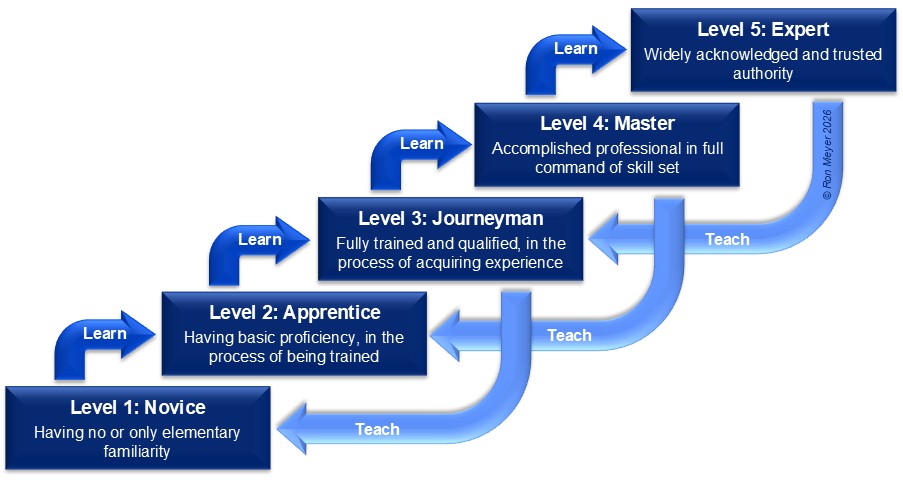
The five competence levels and their roles are the following: