89. Alignment Bridge

1 November 2026
How can I improve cross-unit alignment in my organization?

Key Definitions

An organizational structure is the way that an organization formally divides its value-adding activities, and the people who perform them, into a variety of smaller units. Depending on their size, organizations can be split up into divisions, businesses, regions, departments and teams. This structuring into separate units can be visualized in an org chart.

For organizations to work effectively, these units shouldn’t function as independent silos but require some level of cross-unit alignment – coordination between them to achieve joint goals. This need for alignment doesn’t show up in an org chart but can be captured in process maps, such as value stream diagrams and RACI matrices but both are limited in supporting alignment.

Conceptual Model

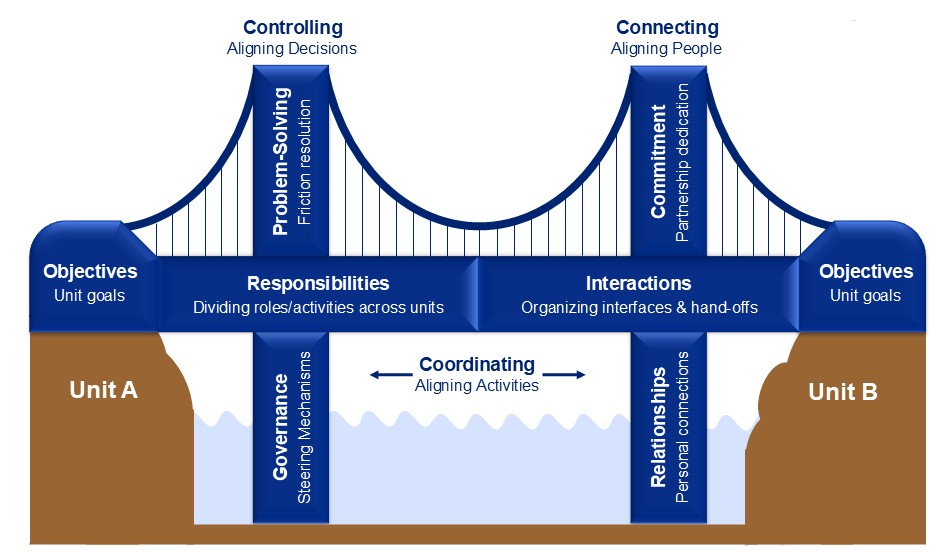
The Alignment Bridge model gives an overview of the key factors required to achieve alignment between two or more units. It suggests that both sides need to bridge the gap between them by first aligning their objectives and then their activities, to realize coordinated value-adding processes (also called value streams) or cross-unit synergies. To “hold up and support” these coordinated activities, both sides also need to align their decisions and their people. To build and maintain the bridge requires continuous effort from both units. This model can be used as a checklist for joint discussions on how to initiate and sustain valuable cross-unit alignment.

Key Elements

The seven factors contributing to effective cross-unit alignment are the following:

  1. Objectives. Alignment should always start with determining why the units need to work together in the first place. Do they follow each other in a process, or does one provide services to the other, or can they achieve joint synergies? Both need to negotiate in which areas they want to cooperate, what they want to achieve and under which conditions.
  2. Responsibilities. Once the shared objectives have been set, the two sides can determine who does what. They can “contract” which activities will be carried out by each side, ensuring that all bases are covered, while there is no unnecessary overlap. Part of the agreement includes clarifying mutual expectations regarding quality, timing and budget.
  3. Interactions. With the activities divided, both parties also need to determine where the interfaces between the activities will be and where products, services or resources will be handed off to the other. The interfaces are moments of contact where coordination or joint activities can take place, while hand offs are the moments of transfer between parties.
  4. Governance. Once the activities have been coordinated, both sides need to determine how related decisions will be made, implemented, reviewed and adjusted, as well as who will be involved in what manner. They must also agree on a joint set of rules and regulations, to control what type of behavior is allowed and expected.
  5. Problem-solving. Yet, even with a well-designed governance set-up, there will always be unforeseen frictions that need to be resolved. Smaller issues can often be tackled by informal contacts on the work floor, but more challenging problems often require more structured problem-solving mechanisms such as trouble-shooting teams or taskforces.
  6. Relationships. Still, alignment requires more than organizational systems and processes. Besides controls to align decisions, personal connections are needed to align people. Individuals need to have workable relationships with each other, built on an understanding of the other’s qualities and mindset. Interpersonal alignment hinges on mutual confidence.
  7. Commitment. Just as good governance doesn’t prevent all problems, good relationships don’t prevent interpersonal frictions, misunderstandings and irritations. Therefore, both sides need to be dedicated to their partnership, willing to work on their relationship and resolve occasional issues, even if it would be easier to blame and shame the other party.

Key Insights

  • Cross-unit alignment is essential but hard. Work is easily divided among people, but much less attention is paid to getting them to work together, especially across units, such as teams or departments. The usual approach is to let a higher level of management enforce cooperation, instead of making alignment the responsibility of the units themselves.
  • Cross-unit alignment starts with aligning objectives. To get two or more units to voluntarily build a bridge over the gap between them, they must begin by clarifying where their interests coincide. This can be the basis of shared goals that motivate cooperation.
  • Cross-unit alignment should focus on aligning activities. With shared goals, both sides need to determine who will take responsibility for which activity and how they will interact.
  • Cross-unit alignment should be supported by aligning decisions and people. Yet, just aligning activities is not enough to ensure smooth coordination. The bridge needs two pillars to hold up and support the aligned activity flow. The first pillar is aligning decisions, by organizing good governance and effective problem-solving. The second pillar is aligning people by building strong relationships and stimulating commitment to the partnership.
  • Cross-unit alignment should be contracted. Often, it is believed that a simple RACI matrix (Responsible, Accountable, Consulted and Informed) is good enough to achieve cross-unit alignment. But using the Alignment Bridge as a framework to “contract” between two or more units is a much richer approach to achieving lasting cross-unit alignment.


Subscribe to our monthly Management Model

Do you want to be notified of our monthly Management Model? Please fill in your email address here.

November 2026
Alignment Bridge

October 2026
Quadruple Diamond Decision-Making

September 2026
Personal Quick Guide

August 2026
Competence Guilds

July 2026
Organizational Partnering Model

June 2026
Feedback Flavors Framework

May 2026
Humanistic Organization

April 2026
Resource Base Dial

March 2026
Personal System Map

February 2026
Five Company-Centric Forces

January 2026
Strategic Assignment Matrix

December 2025
New Learning Curve

November 2025
Organizational Diamond

Oktober 2025
5T SMART Plan

September 2025
Conversation Elevator

August 2025
Innovation Arena

July 2025
Integration Zippers

June 2025
Courageous Core Model

May 2025
Five Phases of Change

April 2025
Frictionless Flow Framework

March 2025
Interaction Drivers

February 2025
Innovation Sins & Virtues

January 2025
Top Line Growth Pie

December 2024
Sustainability Maturity Ladder

November 2024
Self-Centered Thinking Traps

October 2024
Corporate Synergy Typology

September 2024
Guiding STAR Matrix

August 2024
Hunting & Farming Typology

July 2024
Wicked Problem Scorecard

June 2024
Time Management Funnel

May 2024
Digitalization Staircase

April 2024
Leadership Circle Map

March 2024
MOVING Mission Framework

February 2024
BOLD Vision Framework

January 2024
Duty of Care Feedback Model

December 2023
Best Practice Sharing Modes

November 2023
Stakeholder Stance Map

October 2023
Status Snakes & Ladders

September 2023
Customer-Centricity Circle

August 2023
Activity System Dial

July 2023
New Pyramid Principle

June 2023  
Cultural Fabric Model

May 2023       
Corporate Strategy Framework

April 2023  
Ambition Radar Screen

March 2023
Resistance to Change Typology

February 2023   
5I Innovation Pipeline

January 2023     
Thinking Directions Framework

December 2022      
Corporate Management Styles

November 2022     
Strategic Action Model 

October 2022
Psychological Safety Compass

September 2022
The Tree of Power    

August 2022
Value Proposition Dial

July 2022
Sustainable You Model

June 2022
Change Manager’s Toolbox

May 2022
Corporate Value Creation Model

April 2022
Organizational System Map

March 2022
Creativity X-Factor

February 2022
Strategic Alignment Model

January 2022
Market System Map

December 2021
Team Building Cycle

November 2021
Disciplined Dialogue Model

Oktober 2021
Strategy Hourglass

September 2021
Powerhouse Framework

August 2021
Fruits & Nuts Matrix

July 2021
Everest Model of Change

June 2021
Followership Cycle

May 2021
Knowledge Sharing Bridges

April 2021
Innovation Box

March 2021
Empowerment Cycle

February 2021
Digital Distribution Model Dial

January 2021
Digital Product Model Dial

December 2020
4C Leadership Levers

November 2020
Rebound Model of Resilience

October 2020
Strategic Bets Framework

September 2020
Storytelling Scripts

August 2020
7I Roles of the Corporate Center

July 2020
Strategy Development Cycle

June 2020
Rising Star Framework

May 2020
The Control Panel

April 2020
Strategic Agility Model

March 2020
Leadership Fairness Framework

February 2020
11C Synergy Model

January 2020
Competition Tornado

December 2019
Confidence Quotient

November 2019
House of Engagement

October 2019
Revenue Model Framework

September 2019
Interaction Pressure Gauge

August 2019
Digital Platform Map

July 2019
Mind the Gap Model


Double-click to edit button text. crossarrow-leftcross-circle