87. Personal Quick Guide

1 September 2026
How can I give colleagues quick insight into how to work with me?

Key Definitions

A résumé, or curriculum vitae, is a document giving an overview of a person’s past education, jobs, and accomplishments, as well as their qualifications and skills. It is used when applying for a job or new position and focuses on factual information about the person to date.

A résumé is not an introduction to explain how it is to work with someone. Limited information is provided about a person’s strengths and weaknesses, and nothing is said about their preferred way of working. Generally, this insight needs to be discovered along the way.

Conceptual Model

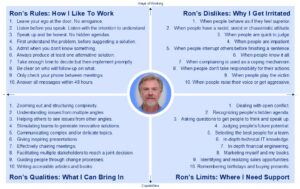
The Personal Quick Guide is a simple template for providing new colleagues or partners with some first insights into how to work with you. It gives a quick introduction to your operational profile, by outlining your preferred ways of working (the top two boxes) and the capabilities you can bring to the table (the bottom two). Below is an example of the types of insights that can be shared with others, using myself as tangible illustration. The more specific your points, the faster others will start to understand how to engage with you. Note that identifying these 40 points not only helps others but also leads to increased self-insight as valuable spin-off.

Key Elements

The four categories giving quick insight into how to work with you are the following:

  1. Your Rules: How You Like To Work. If you could set rules about how people around you should behave, what would these be? What do you believe makes working together effective and efficient, but also what gives you energy and creates flow? Some things will be obvious to everybody (“speak up”) but you want to mention the preferences you have that are not universal (“give at least one alternative”) or that people find difficult to adhere to (“listen before you speak”). Know your unwritten norms and make them written rules.
  2. Your Dislikes: Why You Get Irritated. What are your buttons that other people shouldn’t push? In some cases, these irritants will make you openly angry, which some socially-aware people will understand, but will baffle the less gifted, so it’s better to explain your quirks upfront. In other cases, you might not get angry, because of character or culture, but people’s behavior might still sap your energy and/or disrupt your workflow. Therefore, you need to share your “user’s manual” and help them to avoid short-circuiting you.
  3. Your Qualities: What You Can Bring In. What are your distinctive capabilities that can be useful to others? On résumés people will often mention personal characteristics (“positive”, “team player”), but not specific abilities that can be contributed to the team. Most people find it difficult to recognize their own distinguishing qualities, because these skills are normal to them – as they are good at them, they find them easy to use. Therefore, you will often need to ask others to tell you what you are good at.
  4. Your Limits: Where You Need Support. What are the areas where you need other people to help you out? No one is good at, or has energy for, everything. Yet it can be difficult to accept your own limitations and even more difficult to admit to the people around you that you need their support on specific topics. Still, recognizing your weaker points can be liberating to yourself, as you don’t have to keep up appearances, while showing others that you’re self-aware and only human, which will invite them to assist you where necessary.

Key Insights

  • Your Personal Quick Guide is your user’s manual. Don’t you hate buying a complicated apparatus without a user’s manual and then spending months trying to figure out how it works? The Personal Quick Guide is such an “instruction book on one page”, giving the reader rapid insight into your do’s and don’ts, to speed up their orientation.
  • Your Personal Quick Guide is complementary to your résumé. Just as a sales brochure and a user’s manual are different yet complementary, so too are your résumé and your Personal Quick Guide. Both help to get to know you, but the first is for the job application phase and the latter for the onboarding phase.
  • Your Personal Quick Guide outlines your preferred ways of working. The top half of the Personal Quick Guide gives insight into the process-side of you – how you prefer to work, particularly in interaction with others. Sticking to your rules will facilitate your flow, while triggering your irritants will upset your flow. By stating these, you’re not demanding that people work the way you want but making clear how you will perform at your best.
  • Your Personal Quick Guide outlines your capabilities. The bottom half of the Personal Quick Guide gives insight into the input-side of you – which capabilities you can or can’t bring to the job. Your qualities are your distinctive strengths, while your limitations are your relative weaknesses. By stating these you make it easier for others to know when to call on you and where they can pitch in to help you out.
  • Your Personal Quick Guide also stimulates your self-insight. While the Personal Quick Guide is intended to give others insight into you, drawing it up often also gives you insight into yourself. To explain what makes you different, you need to reflect on yourself and determine where you’re not normal, that is, where you deviate from the norm. Coming up with four or five points is easy, but getting to ten really challenges your self-reflection.


Subscribe to our monthly Management Model

Do you want to be notified of our monthly Management Model? Please fill in your email address here.

September 2026
Personal Quick Guide

August 2026
Competence Guilds

July 2026
Organizational Partnering Model

June 2026
Feedback Flavors Framework

May 2026
Humanistic Organization

April 2026
Resource Base Dial

March 2026
Personal System Map

February 2026
Five Company-Centric Forces

January 2026
Strategic Assignment Matrix

December 2025
New Learning Curve

November 2025
Organizational Diamond

Oktober 2025
5T SMART Plan

September 2025
Conversation Elevator

August 2025
Innovation Arena

July 2025
Integration Zippers

June 2025
Courageous Core Model

May 2025
Five Phases of Change

April 2025
Frictionless Flow Framework

March 2025
Interaction Drivers

February 2025
Innovation Sins & Virtues

January 2025
Top Line Growth Pie

December 2024
Sustainability Maturity Ladder

November 2024
Self-Centered Thinking Traps

October 2024
Corporate Synergy Typology

September 2024
Guiding STAR Matrix

August 2024
Hunting & Farming Typology

July 2024
Wicked Problem Scorecard

June 2024
Time Management Funnel

May 2024
Digitalization Staircase

April 2024
Leadership Circle Map

March 2024
MOVING Mission Framework

February 2024
BOLD Vision Framework

January 2024
Duty of Care Feedback Model

December 2023
Best Practice Sharing Modes

November 2023
Stakeholder Stance Map

October 2023
Status Snakes & Ladders

September 2023
Customer-Centricity Circle

August 2023
Activity System Dial

July 2023
New Pyramid Principle

June 2023  
Cultural Fabric Model

May 2023       
Corporate Strategy Framework

April 2023  
Ambition Radar Screen

March 2023
Resistance to Change Typology

February 2023   
5I Innovation Pipeline

January 2023     
Thinking Directions Framework

December 2022      
Corporate Management Styles

November 2022     
Strategic Action Model 

October 2022
Psychological Safety Compass

September 2022
The Tree of Power    

August 2022
Value Proposition Dial

July 2022
Sustainable You Model

June 2022
Change Manager’s Toolbox

May 2022
Corporate Value Creation Model

April 2022
Organizational System Map

March 2022
Creativity X-Factor

February 2022
Strategic Alignment Model

January 2022
Market System Map

December 2021
Team Building Cycle

November 2021
Disciplined Dialogue Model

Oktober 2021
Strategy Hourglass

September 2021
Powerhouse Framework

August 2021
Fruits & Nuts Matrix

July 2021
Everest Model of Change

June 2021
Followership Cycle

May 2021
Knowledge Sharing Bridges

April 2021
Innovation Box

March 2021
Empowerment Cycle

February 2021
Digital Distribution Model Dial

January 2021
Digital Product Model Dial

December 2020
4C Leadership Levers

November 2020
Rebound Model of Resilience

October 2020
Strategic Bets Framework

September 2020
Storytelling Scripts

August 2020
7I Roles of the Corporate Center

July 2020
Strategy Development Cycle

June 2020
Rising Star Framework

May 2020
The Control Panel

April 2020
Strategic Agility Model

March 2020
Leadership Fairness Framework

February 2020
11C Synergy Model

January 2020
Competition Tornado

December 2019
Confidence Quotient

November 2019
House of Engagement

October 2019
Revenue Model Framework

September 2019
Interaction Pressure Gauge

August 2019
Digital Platform Map

July 2019
Mind the Gap Model


Double-click to edit button text. crossarrow-leftcross-circle