86. Competence Guilds

1 August 2026
How can I build a learning organization?

Key Definitions

Learning is the process of acquiring new knowledge (information and insights), capabilities (routines and skills) and attitudes (values and mindset). Competence development is learning directed at making people more effective at achieving results in a particular area.

Learning can be done by individuals, but knowledge, capabilities and attitudes can also be built up in teams and organizations. Where organizations are adept at continuously learning, from their own experience and external sources, they are called learning organizations – they have learnt how to learn and can constantly upgrade and renew their competencies.

Conceptual Model

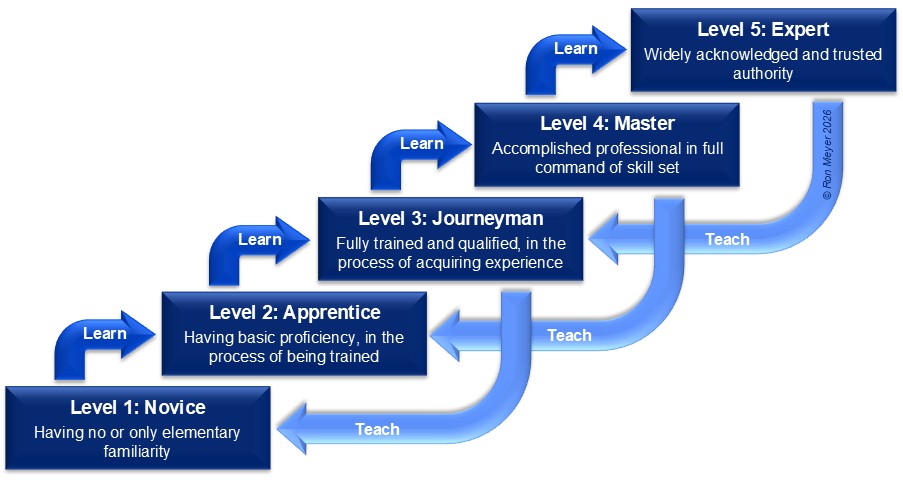
The Competence Guilds framework is a model for building a learning organization. It suggests dividing all organizational members into five levels of ability for each strategically important type of competence. Each individual can then progress through each level by learning (arrows on the left). The key to faster organizational learning is that people at a higher level of competence take the responsibility for teaching people at lower levels (arrows on the right), similar to how guilds used to function. Teaching is not made abstract and outsourced to external schools but kept practical and embraced as a crucial leadership task. The experts and masters in each competence area run their guild together and drive organizational learning. As competence levels don’t necessarily coincide with hierarchical levels, anyone can be involved in leading a guild and everyone can be involved in teaching somewhere.
Key Elements

The five competence levels and their roles are the following:

  1. Level 1: Novice. As newcomers to a competence area, novices need to build up rudimentary familiarity with the topic. Much of this basic learning can be generic, making use of external written materials or training programs. However, some of the introductory teaching can be made more organization-specific and provided by journeymen under supervision of a master. By teaching, journeymen learn just as much as the novices.
  2. Level 2: Apprentice. As trainees, apprentices are insufficiently skilled to operate entirely independently, so they are guided on-the-job by masters and journeymen. By watching their skilled colleagues in action, and receiving coaching by them, apprentices learn-by-doing in the practical context of the organization. This hands-on learning can be complemented by more formalized classroom training by the masters.
  3. Level 3: Journeyman. As fully qualified professionals in a competence area, journeymen are capable of operating independently and typically become increasingly proficient the more they practice. Given their completed training, they are well-positioned to pass on this training to novices, gaining extra experience themselves by doing so. At the same time, they also still learn from the mentoring provided by masters and experts.
  4. Level 4: Master. As accomplished professionals in their competence area, masters set and maintain the internal quality standards of the organization. Given their mastery, they are well-placed to train apprentices, both by example on the job and by formal means in class. Yet, at the same time, they keep learning themselves, from external experts and from other internal masters and experts, who share their insights and best practices.
  5. Level 5: Expert. As authorities in their field, experts are widely cited and consulted by people inside and outside the organization. Given their acknowledged abilities, they lend external credibility to their organizations, while acting as internal role models for masters and journeymen. Practically, they mentor journeymen and spar with masters, which helps them to keep learning, and shows others that learning is never finished.

Key Insights

  • Competence development is of strategic importance. In an ever-changing world, remaining relevant means constantly upgrading existing organizational competencies and developing new ones. This requires ongoing organizational learning.
  • Competence development can be done at five levels. For each specific type of competence, five ability levels can be distinguished. Novices are literally new to the field, while apprentices have taken on the challenge of trying to master a competence. Journeymen have reached the threshold of being able to work competently on their own but still need to fine-tune their art to become true masters. The fifth level of expert is achieved when someone is externally recognized as an authority on the competence.
  • Competence development shouldn’t be outsourced. Organizations can send individuals or even whole teams to external trainers for a one-off update, yet this seldom leads to a jump in competence and doesn’t help the organization to continuously develop its competences itself. Organizations need to organize their own organizational learning.
  • Competence development can be driven by competence guilds. A powerful way of structuring organizational learning is to organize competence-specific guilds, in which the experts and masters take responsibility for driving competence development, by determining what needs to be upgraded in future, while mentoring and teaching others.
  • Competence guilds need to be organized. As competence levels and management levels don’t necessarily coincide, competence guilds need to be organized as separate learning communities, with their own leaders, objectives, ways of working and budget.
Subscribe to our monthly Management Model

Do you want to be notified of our monthly Management Model? Please fill in your email address here.

August 2026
Competence Guilds

July 2026
Organizational Partnering Model

June 2026
Feedback Flavors Framework

May 2026
Humanistic Organization

April 2026
Resource Base Dial

March 2026
Personal System Map

February 2026
Five Company-Centric Forces

January 2026
Strategic Assignment Matrix

December 2025
New Learning Curve

November 2025
Organizational Diamond

Oktober 2025
5T SMART Plan

September 2025
Conversation Elevator

August 2025
Innovation Arena

July 2025
Integration Zippers

June 2025
Courageous Core Model

May 2025
Five Phases of Change

April 2025
Frictionless Flow Framework

March 2025
Interaction Drivers

February 2025
Innovation Sins & Virtues

January 2025
Top Line Growth Pie

December 2024
Sustainability Maturity Ladder

November 2024
Self-Centered Thinking Traps

October 2024
Corporate Synergy Typology

September 2024
Guiding STAR Matrix

August 2024
Hunting & Farming Typology

July 2024
Wicked Problem Scorecard

June 2024
Time Management Funnel

May 2024
Digitalization Staircase

April 2024
Leadership Circle Map

March 2024
MOVING Mission Framework

February 2024
BOLD Vision Framework

January 2024
Duty of Care Feedback Model

December 2023
Best Practice Sharing Modes

November 2023
Stakeholder Stance Map

October 2023
Status Snakes & Ladders

September 2023
Customer-Centricity Circle

August 2023
Activity System Dial

July 2023
New Pyramid Principle

June 2023  
Cultural Fabric Model

May 2023       
Corporate Strategy Framework

April 2023  
Ambition Radar Screen

March 2023
Resistance to Change Typology

February 2023   
5I Innovation Pipeline

January 2023     
Thinking Directions Framework

December 2022      
Corporate Management Styles

November 2022     
Strategic Action Model 

October 2022
Psychological Safety Compass

September 2022
The Tree of Power    

August 2022
Value Proposition Dial

July 2022
Sustainable You Model

June 2022
Change Manager’s Toolbox

May 2022
Corporate Value Creation Model

April 2022
Organizational System Map

March 2022
Creativity X-Factor

February 2022
Strategic Alignment Model

January 2022
Market System Map

December 2021
Team Building Cycle

November 2021
Disciplined Dialogue Model

Oktober 2021
Strategy Hourglass

September 2021
Powerhouse Framework

August 2021
Fruits & Nuts Matrix

July 2021
Everest Model of Change

June 2021
Followership Cycle

May 2021
Knowledge Sharing Bridges

April 2021
Innovation Box

March 2021
Empowerment Cycle

February 2021
Digital Distribution Model Dial

January 2021
Digital Product Model Dial

December 2020
4C Leadership Levers

November 2020
Rebound Model of Resilience

October 2020
Strategic Bets Framework

September 2020
Storytelling Scripts

August 2020
7I Roles of the Corporate Center

July 2020
Strategy Development Cycle

June 2020
Rising Star Framework

May 2020
The Control Panel

April 2020
Strategic Agility Model

March 2020
Leadership Fairness Framework

February 2020
11C Synergy Model

January 2020
Competition Tornado

December 2019
Confidence Quotient

November 2019
House of Engagement

October 2019
Revenue Model Framework

September 2019
Interaction Pressure Gauge

August 2019
Digital Platform Map

July 2019
Mind the Gap Model


Double-click to edit button text. crossarrow-leftcross-circle