
Each person is a complex system of interconnected parts, that defies a simple division into independent building blocks. Still, it can be analytically useful to unravel people into a few key elements, to understand which parts are more susceptible to development than others.
For centuries, philosophers, scientists and amateur psychologists have debated whether people are largely shaped by nature (genes) or nurture (learning), and to what extent their characteristics are stable or can change over time. However, it is safe to say that at least some aspects of a personal system have been learnt and can be developed further moving forward.
The Personal System Map is an analytical framework (building on Meyer & Meijers, 2018) for understanding which elements make up who a person is, and which will be easier to develop over time. Using the metaphor of a planet, the model suggests that each person consists of four layers, with each deeper one being less adaptable. At the same time, each person is embedded in four external systems that, as four linked types of atmosphere, influence the planet from the outside-in. The message is that people are partially shaped by the systems (also called institutions) they operate in and that the most effective way to develop is to also change from the outside-in – changing positions and roles first and then working inwards.
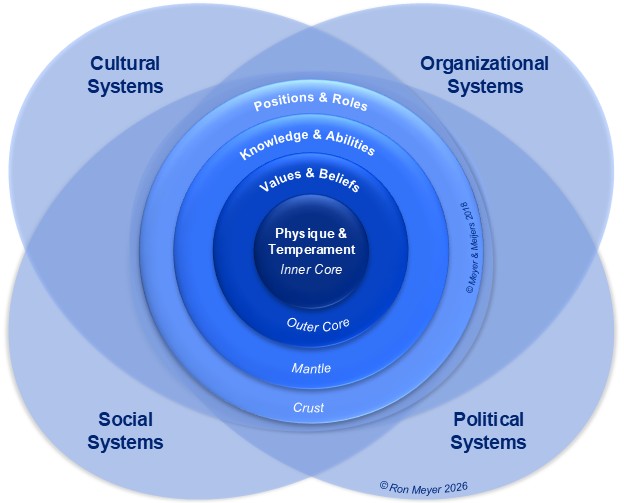
The four layers making up each individual are the following:
Positions and roles are part of a personal system (you are your position/role), but at the same time they are also part of one of these external systems: