79. Strategic Assignment Matrix

1 January 2026
Which strategic assignment should I give to each business unit in my portfolio?

Key Definitions

A corporation has a portfolio of business units when it consists of two or more operating companies, each requiring a separate strategy because they compete in different markets.

While each business unit will typically strive to have a unique competitive strategy, the corporate center will give them a more general strategic assignment to grow, consolidate, turnaround or leave. Corporate investment in each business unit, and the expected future performance, will all be aligned with this specific strategic assignment.

Conceptual Model

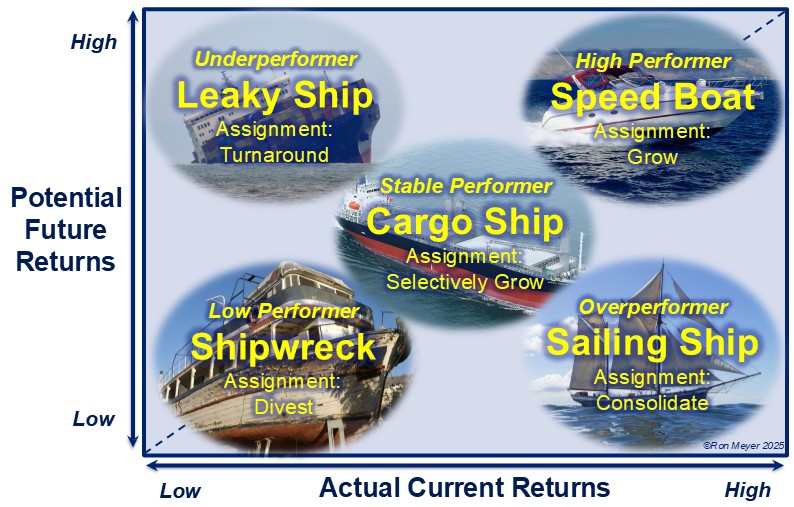
The Strategic Assignment Matrix is an analytical framework for setting the overall strategic objective for each business unit in a corporate portfolio. It is based on a comparison between the current returns achieved by each unit and their potential future performance. The current performance, however measured, is known for each unit, allowing each to be plotted on the horizontal axis, with the expected average return in the middle. Then an analysis of each unit’s potential future performance needs to be made, based on a projection of market attractiveness and the unit’s competitive strength. The resulting position on the vertical axis is both an analytical estimation and a tangible future target. The outcome for each unit will be one of five strategic assignments, with linked room for investment. Ideally, the analysis and conclusions should be jointly agreed on by the corporate center and business units.

Key Elements

The five possible strategic assignments are the following:

  1. Grow: For High Performing Speedboats. Any business unit that is currently reaching above average returns and has a realistic possibility to keep on achieving superior performance in the coming years, has earned the right, but also has the duty, to invest in further growth. Their assignment will be to realize their potential, by increasing their topline and/or margins in a way that is sustainable in the longer run.
  2. Selectively Grow: For Stable Performing Cargo Ships. Business units with healthy returns and the prospect of staying that way for the foreseeable future, need to selectively bet on growth opportunities, while keeping their base business stable and up to date. Their assignment will be to stay in shape, by prudently investing in improvements and renewal, to keep their returns on par.
  3. Turnaround: For Underperforming Leaky Ships. Achieving lower than average returns is a clear indication that the business unit has sprung a leak. It can be an old vessel that hasn’t been properly maintained, or a new one with some start-up challenges. If the future potential is still positive, investments should be made to rapidly turn the situation around. The assignment will be to quickly plug the leak and prove the ship is still seaworthy.
  4. Divest: For Low Performing Shipwrecks. If the future potential of a poorly performing business unit is unattractive, then investing to plug leaks will not suddenly make a shipwreck seaworthy. Valiantly investing in a sinking ship will only suck the captain down with it. The assignment will be to decisively withdraw from the business, often by divesting it to another shipyard or even by dismantling it, to salvage some reusable parts.
  5. Consolidate: For Overperforming Sailing Ships. Some business units are like old sailing ships; they’re still operating well, but they’re not the ships of the future. As their longer-term potential is limited, selective investments should be focused on maintenance and sustaining the existing business. Their assignment will be to prolong their lifespan, getting as much mileage out of the existing resources and relations as possible.

Key Insights

  • Strategic assignments are about future investments. In a corporation with two or more business units, the corporate center must decide like a financial investor in which parts of the portfolio to inject capital, which to hold and which to divest. But while an outside investor can only passively allocate capital, the corporate center can actively assign units the objective to grow, consolidate or exit the business.
  • Strategic assignments depend on current and future performance. When determining which assignment to give each unit, the corporate center will contrast how well each unit is currently performing, which is known, with its future performance potential, which needs to be analyzed by considering the future market attractiveness and the unit’s potential competitive position. Current and future performance potential are plotted in the matrix.
  • Strategic assignments come in five flavors. The five generic strategic assignments are grow, selectively grow, turnaround, divest and consolidate. Each assignment provides a business unit with the general direction on which to base their detailed business strategy.
  • Strategic assignments need to be managed differently. While each business unit needs to tailor its strategy to fit its strategic assignment, the corporate center will need to manage the various categories of business units differently. Especially the businesses with a turnaround and divest assignment might require a separate approach and/or team.
  • The Strategic Assignment Matrix is a complementary portfolio analysis tool. Most other portfolio analysis tools, such as the BCG Matrix and GE Business Screen, map each unit’s future potential, but don’t suggest a strategic assignment. The Strategic Assignment Matrix is a complementary tool that can best be used after a first portfolio analysis to agree on the strategic assignment that each unit will be given.
Subscribe to our monthly Management Model

Do you want to be notified of our monthly Management Model? Please fill in your email address here.

January 2026
Strategic Assignment Matrix

December 2025
New Learning Curve

November 2025
Organizational Diamond

Oktober 2025
5T SMART Plan

September 2025
Conversation Elevator

August 2025
Innovation Arena

July 2025
Integration Zippers

June 2025
Courageous Core Model

May 2025
Five Phases of Change

April 2025
Frictionless Flow Framework

March 2025
Interaction Drivers

February 2025
Innovation Sins & Virtues

January 2025
Top Line Growth Pie

December 2024
Sustainability Maturity Ladder

November 2024
Self-Centered Thinking Traps

October 2024
Corporate Synergy Typology

September 2024
Guiding STAR Matrix

August 2024
Hunting & Farming Typology

July 2024
Wicked Problem Scorecard

June 2024
Time Management Funnel

May 2024
Digitalization Staircase

April 2024
Leadership Circle Map

March 2024
MOVING Mission Framework

February 2024
BOLD Vision Framework

January 2024
Duty of Care Feedback Model

December 2023
Best Practice Sharing Modes

November 2023
Stakeholder Stance Map

October 2023
Status Snakes & Ladders

September 2023
Customer-Centricity Circle

August 2023
Activity System Dial

July 2023
New Pyramid Principle

June 2023  
Cultural Fabric Model

May 2023       
Corporate Strategy Framework

April 2023  
Ambition Radar Screen

March 2023
Resistance to Change Typology

February 2023   
5I Innovation Pipeline

January 2023     
Thinking Directions Framework

December 2022      
Corporate Management Styles

November 2022     
Strategic Action Model 

October 2022
Psychological Safety Compass

September 2022
The Tree of Power    

August 2022
Value Proposition Dial

July 2022
Sustainable You Model

June 2022
Change Manager’s Toolbox

May 2022
Corporate Value Creation Model

April 2022
Organizational System Map

March 2022
Creativity X-Factor

February 2022
Strategic Alignment Model

January 2022
Market System Map

December 2021
Team Building Cycle

November 2021
Disciplined Dialogue Model

Oktober 2021
Strategy Hourglass

September 2021
Powerhouse Framework

August 2021
Fruits & Nuts Matrix

July 2021
Everest Model of Change

June 2021
Followership Cycle

May 2021
Knowledge Sharing Bridges

April 2021
Innovation Box

March 2021
Empowerment Cycle

February 2021
Digital Distribution Model Dial

January 2021
Digital Product Model Dial

December 2020
4C Leadership Levers

November 2020
Rebound Model of Resilience

October 2020
Strategic Bets Framework

September 2020
Storytelling Scripts

August 2020
7I Roles of the Corporate Center

July 2020
Strategy Development Cycle

June 2020
Rising Star Framework

May 2020
The Control Panel

April 2020
Strategic Agility Model

March 2020
Leadership Fairness Framework

February 2020
11C Synergy Model

January 2020
Competition Tornado

December 2019
Confidence Quotient

November 2019
House of Engagement

October 2019
Revenue Model Framework

September 2019
Interaction Pressure Gauge

August 2019
Digital Platform Map

July 2019
Mind the Gap Model


Double-click to edit button text. crossarrow-leftcross-circle