77. Organizational Diamond

1 November 2025
How can I structure my organization in the most effective way?

Key Definitions

An organization is a group of people striving towards a shared goal over a prolonged period of time, who have divided the necessary work between them (differentiation), while coordinating their efforts (integration) to achieve the intended result together (Lawrence and Lorsch, 1967).

An organizational structure is the design used to divide work activities between units and individuals (task allocation), while ensuring that, where necessary, these activities are aligned (task coordination) and they are performed efficiently and effectively (task supervision).

Conceptual Model

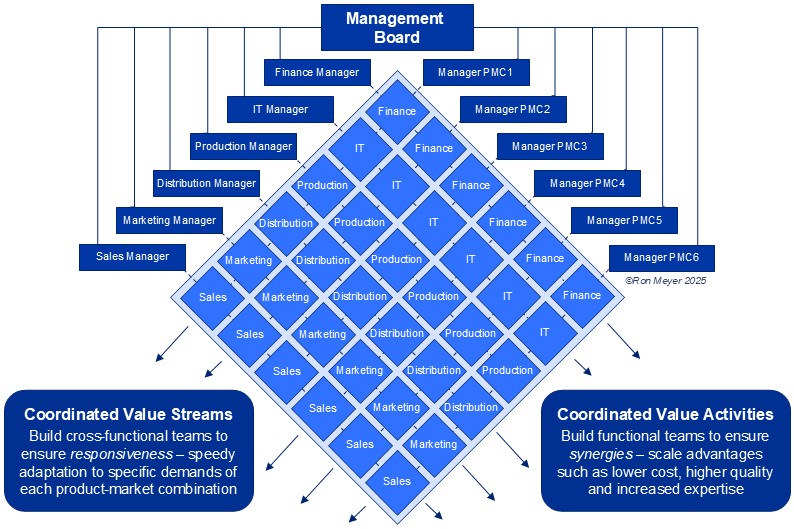
The Organizational Diamond framework offers a simple key for designing even complex organizations. It is based on the premise that when structuring an organization designers need to balance, on the one hand, the advantages of keeping similar value activities together in functional teams (diagonally on the left), with on the other hand the advantages of keeping complementary value activities together in cross-functional value stream teams (diagonally on the right). In other words, every organizational design is fundamentally a balancing act between achieving internal synergies and external responsiveness. When deciding on the most effective structure, this trade-off needs to be considered at various levels of aggregation.

Key Elements

The two fundamental design principles are the following:

  1. Coordinate Value Activities to Achieve Synergies. Keeping similar value-adding activities together in one person or department can create scale advantages, such as lower cost, higher quality and increased expertise. This is the internal functional team logic, usually leading to functional managers at the head of departments (see top left). However, these synergies are only viable if the activities are (made) similar enough.
  2. Coordinate Value Streams to Achieve Responsiveness. Keeping complementary value-adding activities together in one person or department can create responsiveness advantages, such as market adaptability and customer-centricity. This is the external cross-functional team logic that is particularly important if markets are very different. This leads to having business unit, product line and/or regional managers as department heads.

The framework then suggests the following organizational design process:

  1. Evaluate Building Blocks Bottom-Up:
    1. Map out all main value-adding activities. Determine a detailed picture of all of the work that needs to be done (the light blue examples in the diagram, but more detailed).
    2. Assess the responsiveness advantages. Determine how different each product-market combination (PMC) is and what the benefits of tailoring to each would be.
    3. Assess the synergy advantages. Determine how similar various activities are and how large the scale benefits could be.
  2. Structure Building Blocks Top-Down:
  3. Design main structure. Determine whether the main structure will be function-based or market-based (by business, region or customer group). At the next level do the same.
  4. Design secondary structure. Determine where the “fixed line” coordination needs to be supported by “dotted line” coordination. Do this at every level, from the top down.
  5. Slot people into the structure. Determine which person should be on which team, to carry out which activities. Recruit/replace people to fit with the activities.

Key Insights

  • Organizational design is about value creation. Organizations are groups of people, but their design shouldn’t be based on the people, but on the value they are intended to create. Organizations should be fit for purpose, so structuring them starts with understanding which value-adding activities need to be carried out and how these can be performed as efficiently and effectively as possible. So, first structure the activities, then add the people.
  • Organizational design balances internal and external logics. All the value-adding activities can be coordinated in two ways: similar activities can be clustered to create internally oriented synergies, while complementary activities can be clustered to achieve externally oriented responsiveness. These opposite possibilities need to be balanced.
  • Organizational design should always start with business design. Whether the diamond should tip to the right, emphasizing functional synergies, or tip to the left, focusing on market responsiveness, depends on the chosen business strategy. Structure follows strategy (Chandler, 1962). The business model determines which activities to coordinate.
  • Organizational design should be bottom-up and then top-down. Structuring should start with a bottom-up understanding of all the required value-adding activities and the potential for synergy and responsiveness advantages. Only then can clustering choices be made, starting from the top down, with a first level of structuring, followed by multiple next levels, each time using the same internal-external advantage trade-off.
  • Organizational design balanced fixed line and dotted line. While the main structure determines the formal divisions and reporting lines, there is usually still room to coordinate between activities across units/departments using a variety of “dotted line” integration mechanisms. See the 11C Synergy Model (#8) and Customer-Centricity Model (#51).
Subscribe to our monthly Management Model

Do you want to be notified of our monthly Management Model? Please fill in your email address here.

December 2025
New Learning Curve

November 2025
Organizational Diamond

Oktober 2025
5T SMART Plan

September 2025
Conversation Elevator

August 2025
Innovation Arena

July 2025
Integration Zippers

June 2025
Courageous Core Model

May 2025
Five Phases of Change

April 2025
Frictionless Flow Framework

March 2025
Interaction Drivers

February 2025
Innovation Sins & Virtues

January 2025
Top Line Growth Pie

December 2024
Sustainability Maturity Ladder

November 2024
Self-Centered Thinking Traps

October 2024
Corporate Synergy Typology

September 2024
Guiding STAR Matrix

August 2024
Hunting & Farming Typology

July 2024
Wicked Problem Scorecard

June 2024
Time Management Funnel

May 2024
Digitalization Staircase

April 2024
Leadership Circle Map

March 2024
MOVING Mission Framework

February 2024
BOLD Vision Framework

January 2024
Duty of Care Feedback Model

December 2023
Best Practice Sharing Modes

November 2023
Stakeholder Stance Map

October 2023
Status Snakes & Ladders

September 2023
Customer-Centricity Circle

August 2023
Activity System Dial

July 2023
New Pyramid Principle

June 2023  
Cultural Fabric Model

May 2023       
Corporate Strategy Framework

April 2023  
Ambition Radar Screen

March 2023
Resistance to Change Typology

February 2023   
5I Innovation Pipeline

January 2023     
Thinking Directions Framework

December 2022      
Corporate Management Styles

November 2022     
Strategic Action Model 

October 2022
Psychological Safety Compass

September 2022
The Tree of Power    

August 2022
Value Proposition Dial

July 2022
Sustainable You Model

June 2022
Change Manager’s Toolbox

May 2022
Corporate Value Creation Model

April 2022
Organizational System Map

March 2022
Creativity X-Factor

February 2022
Strategic Alignment Model

January 2022
Market System Map

December 2021
Team Building Cycle

November 2021
Disciplined Dialogue Model

Oktober 2021
Strategy Hourglass

September 2021
Powerhouse Framework

August 2021
Fruits & Nuts Matrix

July 2021
Everest Model of Change

June 2021
Followership Cycle

May 2021
Knowledge Sharing Bridges

April 2021
Innovation Box

March 2021
Empowerment Cycle

February 2021
Digital Distribution Model Dial

January 2021
Digital Product Model Dial

December 2020
4C Leadership Levers

November 2020
Rebound Model of Resilience

October 2020
Strategic Bets Framework

September 2020
Storytelling Scripts

August 2020
7I Roles of the Corporate Center

July 2020
Strategy Development Cycle

June 2020
Rising Star Framework

May 2020
The Control Panel

April 2020
Strategic Agility Model

March 2020
Leadership Fairness Framework

February 2020
11C Synergy Model

January 2020
Competition Tornado

December 2019
Confidence Quotient

November 2019
House of Engagement

October 2019
Revenue Model Framework

September 2019
Interaction Pressure Gauge

August 2019
Digital Platform Map

July 2019
Mind the Gap Model


Double-click to edit button text. crossarrow-leftcross-circle