
An ability is the potential to act competently – a skill to do something well. Some abilities take place in people’s heads, such as thinking and feeling, but many more express themselves in behaviors, such as speaking, writing, listening, standing, moving and looking.
Learning is the process of improving one’s knowledge and/or abilities. Some learning can take place quickly, but learning abilities usually requires practice, as uncomfortable new behaviors need to become comfortable routines. This is particularly true if the new ability clashes with ingrained habits and/or deeply held beliefs, or if someone has limited innate talent in that area.
The New Learning Curve model presents an overview of how people acquire a new ability. It suggests they typically go through five phases, from not knowing they don’t have an ability (phase 1) to mastery (phase 5), requiring four different types of learning to move from each phase to the next. It is important to note that the horizontal axis doesn’t depict regular time, but rather the moment at which the learning takes place. It runs from learning by reflecting on the results after trying, to recognizing what works while doing, to gaining insight even before acting. In this sense, the time axis is reversed. The model’s message is not only that mastery takes time, but that people need to change their type of learning along the way. The model’s name is a nod to the “old” learning curve, that posits that ability simply increases with experience.
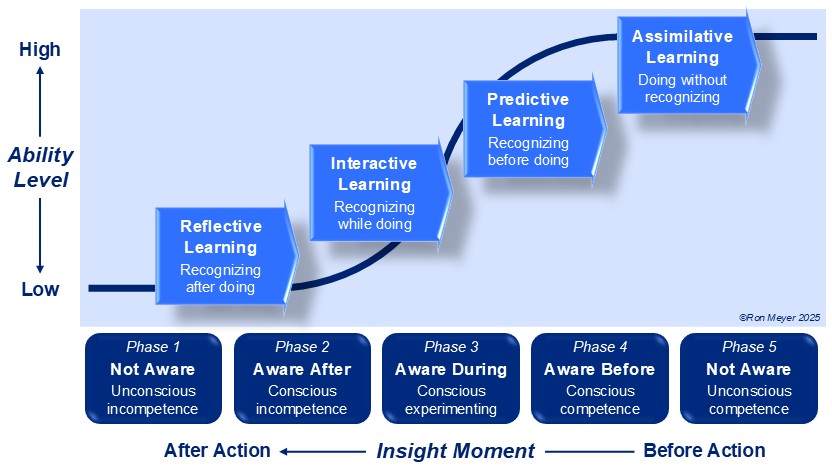
The four sequential types of learning needed to master a new ability are the following: