88. Quadruple Diamond Decision-Making
Key Definitions
Decision-making is the reasoning process whereby a person or group of people arrive at a particular choice. It is more than only decision-taking, which is the selection of one alternative out of several options. Decision-making also encompasses the prior steps of defining the issue for which a decision is needed and generating the options from which to select a decision.
Decision-making is effective if a solution is found to the problem identified (decision suitability), the solution can likely be put into practice (decision feasibility) and the solution is supported by enough stakeholders (decision acceptability). Decision-making is efficient if the process doesn’t take too much time, energy and resources of too many people.
Conceptual Model
The Quadruple Diamond Decision-Making model suggests a decision-making process for teams that combines effectiveness and efficiency. It is an extension of the well-known Double Diamond model, launched by the British Design Council in 2005. This initial framework introduced the two middle diamonds – the first focused on interpreting a problem and the second on formulating a solution – both using the same approach of first diverging to scout for alternatives before then converging on a specific outcome. The Quadruple Diamond model adds two extra diamonds to turn this problem-solving approach into a full decision-making approach. At the beginning, it adds a diamond aimed at identifying which problem to focus on, while also adding a diamond at the end, aimed at jointly deciding on a proposed solution as whole team. Although this model introduces two extra steps to expand problem-solving into decision-making, it still improves efficiency by not involving the entire team in each step.

Key Elements
The four steps in the team decision-making process are the following:
- Identifying: Scout & Scope. The first step is to determine which potential issues require decision-making at all. In this approach, any team member can put a topic they think is important on the meeting agenda (an “identification agenda item”). If after reviewing this issue from different perspectives during the meeting (divergence), it is deemed important enough for further consideration, the team should turn to scoping an assignment (convergence) for a group of 2 or 3 people to formulate a preferred solution and to present this proposal to the whole team as “decision agenda item” within a fixed period of time.
- Interpreting: Challenge & Frame. The second step is for the small team to rethink the initial problem definition in their assignment, as the whole team usually doesn’t have the time to delve that deeply. This process of reframing also starts with divergence, by zooming in to the underlying issues and zooming out to see the bigger picture, while simultaneously trying to understand how different stakeholders view the topic. After exploring the issue from multiple perspectives and challenging the initial interpretation, the team then needs to converge on a richer, reframed formulation assignment.
- Formulating: Develop & Select. The third step is for the small team to come up with the best possible solution, which often is not the most obvious one. To spark creativity and avoid the trap of following existing recipes, the small team again needs to diverge, generating a range of potential solutions, each with their own mix of benefits, costs and risks. Only once multiple options have been formulated should the small team switch to converging, by evaluating and comparing the various alternatives, and then selecting the most appealing one for presentation as decision agenda item to the whole team.
- Deciding: Review & Decide. The fourth step is to get the buy in of the whole team. Again, this starts with divergence, reviewing the small team’s proposal from different perspectives and using various evaluation criteria to test its robustness. During this discussion, minor elements can be fine-tuned on the spot, but if larger questions arise, the team can “decide not to decide” and send the proposal back for further development. However, if the team feels comfortable with the proposal, they can converge on a formal joint decision, including agreement on the who, when and how of the required follow-up.
Key Insights
- Team decision-making should be done in four steps. For simple issues, teams can take the quick and dirty approach of “jumping to solutions”, but for more important issues teams should go through four steps: first identifying which issue requires decision-making, then interpreting the issue, formulating various options and finally deciding what to do.
- Team decision-making should switch between divergence and convergence. To avoid getting stuck in one way of thinking, in each step the decision-makers need to first generate alternatives (divergence) before selecting the best fitting one (convergence).
- Team decision-making should switch between whole and small team work. To save time and energy, the middle two steps should be carried out in a small team (2-3 people). To ensure buy in from the whole team, the first and last steps need to be done jointly.
- Team decision-making meetings should have identification and decision items. To save time, the agenda of the whole team should only consist of two types of items, namely identification items, which can result in giving a small team a “formulation assignment”, and decision items, which can be accepted or sent back to the small team for further work.
- Team decision-making is more than team problem-solving. The double diamond model is intended for creative problem-solving and is at the heart of the quadruple diamond model. But for creative decision-making, an extra first and last step are required.
Key Definitions
A résumé, or curriculum vitae, is a document giving an overview of a person’s past education, jobs, and accomplishments, as well as their qualifications and skills. It is used when applying for a job or new position and focuses on factual information about the person to date.
A résumé is not an introduction to explain how it is to work with someone. Limited information is provided about a person’s strengths and weaknesses, and nothing is said about their preferred way of working. Generally, this insight needs to be discovered along the way.
Conceptual Model
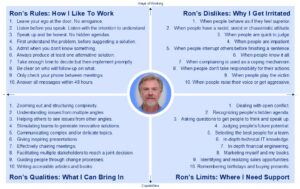
The Personal Quick Guide is a simple template for providing new colleagues or partners with some first insights into how to work with you. It gives a quick introduction to your operational profile, by outlining your preferred ways of working (the top two boxes) and the capabilities you can bring to the table (the bottom two). Below is an example of the types of insights that can be shared with others, using myself as tangible illustration. The more specific your points, the faster others will start to understand how to engage with you. Note that identifying these 40 points not only helps others but also leads to increased self-insight as valuable spin-off.
Key Elements
The four categories giving quick insight into how to work with you are the following:
- Your Rules: How You Like To Work. If you could set rules about how people around you should behave, what would these be? What do you believe makes working together effective and efficient, but also what gives you energy and creates flow? Some things will be obvious to everybody (“speak up”) but you want to mention the preferences you have that are not universal (“give at least one alternative”) or that people find difficult to adhere to (“listen before you speak”). Know your unwritten norms and make them written rules.
- Your Dislikes: Why You Get Irritated. What are your buttons that other people shouldn’t push? In some cases, these irritants will make you openly angry, which some socially-aware people will understand, but will baffle the less gifted, so it’s better to explain your quirks upfront. In other cases, you might not get angry, because of character or culture, but people’s behavior might still sap your energy and/or disrupt your workflow. Therefore, you need to share your “user’s manual” and help them to avoid short-circuiting you.
- Your Qualities: What You Can Bring In. What are your distinctive capabilities that can be useful to others? On résumés people will often mention personal characteristics (“positive”, “team player”), but not specific abilities that can be contributed to the team. Most people find it difficult to recognize their own distinguishing qualities, because these skills are normal to them – as they are good at them, they find them easy to use. Therefore, you will often need to ask others to tell you what you are good at.
- Your Limits: Where You Need Support. What are the areas where you need other people to help you out? No one is good at, or has energy for, everything. Yet it can be difficult to accept your own limitations and even more difficult to admit to the people around you that you need their support on specific topics. Still, recognizing your weaker points can be liberating to yourself, as you don’t have to keep up appearances, while showing others that you’re self-aware and only human, which will invite them to assist you where necessary.
Key Insights
- Your Personal Quick Guide is your user’s manual. Don’t you hate buying a complicated apparatus without a user’s manual and then spending months trying to figure out how it works? The Personal Quick Guide is such an “instruction book on one page”, giving the reader rapid insight into your do’s and don’ts, to speed up their orientation.
- Your Personal Quick Guide is complementary to your résumé. Just as a sales brochure and a user’s manual are different yet complementary, so too are your résumé and your Personal Quick Guide. Both help to get to know you, but the first is for the job application phase and the latter for the onboarding phase.
- Your Personal Quick Guide outlines your preferred ways of working. The top half of the Personal Quick Guide gives insight into the process-side of you – how you prefer to work, particularly in interaction with others. Sticking to your rules will facilitate your flow, while triggering your irritants will upset your flow. By stating these, you’re not demanding that people work the way you want but making clear how you will perform at your best.
- Your Personal Quick Guide outlines your capabilities. The bottom half of the Personal Quick Guide gives insight into the input-side of you – which capabilities you can or can’t bring to the job. Your qualities are your distinctive strengths, while your limitations are your relative weaknesses. By stating these you make it easier for others to know when to call on you and where they can pitch in to help you out.
- Your Personal Quick Guide also stimulates your self-insight. While the Personal Quick Guide is intended to give others insight into you, drawing it up often also gives you insight into yourself. To explain what makes you different, you need to reflect on yourself and determine where you’re not normal, that is, where you deviate from the norm. Coming up with four or five points is easy, but getting to ten really challenges your self-reflection.
Key Definitions
Learning is the process of acquiring new knowledge (information and insights), capabilities (routines and skills) and attitudes (values and mindset). Competence development is learning directed at making people more effective at achieving results in a particular area.
Learning can be done by individuals, but knowledge, capabilities and attitudes can also be built up in teams and organizations. Where organizations are adept at continuously learning, from their own experience and external sources, they are called learning organizations – they have learnt how to learn and can constantly upgrade and renew their competencies.
Conceptual Model
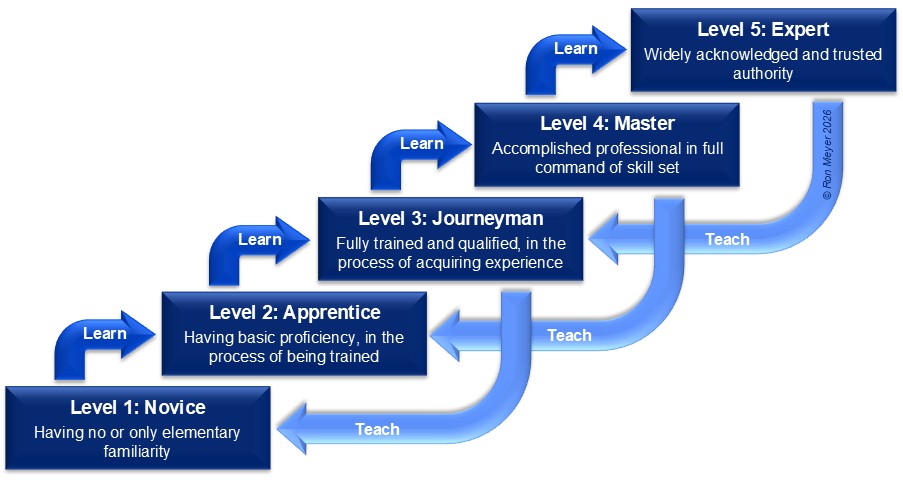
The Competence Guilds framework is a model for building a learning organization. It suggests dividing all organizational members into five levels of ability for each strategically important type of competence. Each individual can then progress through each level by learning (arrows on the left). The key to faster organizational learning is that people at a higher level of competence take the responsibility for teaching people at lower levels (arrows on the right), similar to how guilds used to function. Teaching is not made abstract and outsourced to external schools but kept practical and embraced as a crucial leadership task. The experts and masters in each competence area run their guild together and drive organizational learning. As competence levels don’t necessarily coincide with hierarchical levels, anyone can be involved in leading a guild and everyone can be involved in teaching somewhere.
Key Elements
The five competence levels and their roles are the following:
- Level 1: Novice. As newcomers to a competence area, novices need to build up rudimentary familiarity with the topic. Much of this basic learning can be generic, making use of external written materials or training programs. However, some of the introductory teaching can be made more organization-specific and provided by journeymen under supervision of a master. By teaching, journeymen learn just as much as the novices.
- Level 2: Apprentice. As trainees, apprentices are insufficiently skilled to operate entirely independently, so they are guided on-the-job by masters and journeymen. By watching their skilled colleagues in action, and receiving coaching by them, apprentices learn-by-doing in the practical context of the organization. This hands-on learning can be complemented by more formalized classroom training by the masters.
- Level 3: Journeyman. As fully qualified professionals in a competence area, journeymen are capable of operating independently and typically become increasingly proficient the more they practice. Given their completed training, they are well-positioned to pass on this training to novices, gaining extra experience themselves by doing so. At the same time, they also still learn from the mentoring provided by masters and experts.
- Level 4: Master. As accomplished professionals in their competence area, masters set and maintain the internal quality standards of the organization. Given their mastery, they are well-placed to train apprentices, both by example on the job and by formal means in class. Yet, at the same time, they keep learning themselves, from external experts and from other internal masters and experts, who share their insights and best practices.
- Level 5: Expert. As authorities in their field, experts are widely cited and consulted by people inside and outside the organization. Given their acknowledged abilities, they lend external credibility to their organizations, while acting as internal role models for masters and journeymen. Practically, they mentor journeymen and spar with masters, which helps them to keep learning, and shows others that learning is never finished.
Key Insights
- Competence development is of strategic importance. In an ever-changing world, remaining relevant means constantly upgrading existing organizational competencies and developing new ones. This requires ongoing organizational learning.
- Competence development can be done at five levels. For each specific type of competence, five ability levels can be distinguished. Novices are literally new to the field, while apprentices have taken on the challenge of trying to master a competence. Journeymen have reached the threshold of being able to work competently on their own but still need to fine-tune their art to become true masters. The fifth level of expert is achieved when someone is externally recognized as an authority on the competence.
- Competence development shouldn’t be outsourced. Organizations can send individuals or even whole teams to external trainers for a one-off update, yet this seldom leads to a jump in competence and doesn’t help the organization to continuously develop its competences itself. Organizations need to organize their own organizational learning.
- Competence development can be driven by competence guilds. A powerful way of structuring organizational learning is to organize competence-specific guilds, in which the experts and masters take responsibility for driving competence development, by determining what needs to be upgraded in future, while mentoring and teaching others.
- Competence guilds need to be organized. As competence levels and management levels don’t necessarily coincide, competence guilds need to be organized as separate learning communities, with their own leaders, objectives, ways of working and budget.
85. Organizational Partnering Model
Key Definitions
Interorganizational relations are the connections that an organization has with other parties in the industry value chain, such as suppliers, contractors, distributors, buyers, and competitors, but also with other contextual actors such as unions, governments, universities, and the media.
In the value chain, relations have traditionally been characterized as transactional (market-based) or controlled (hierarchy-based) – the actors were either independent of each other (at arm’s length) or dependent on each other (fully integrated). Between these two extremes lay cooperative relationships (partnership-based), whereby the two parties are interdependent.
Conceptual Model
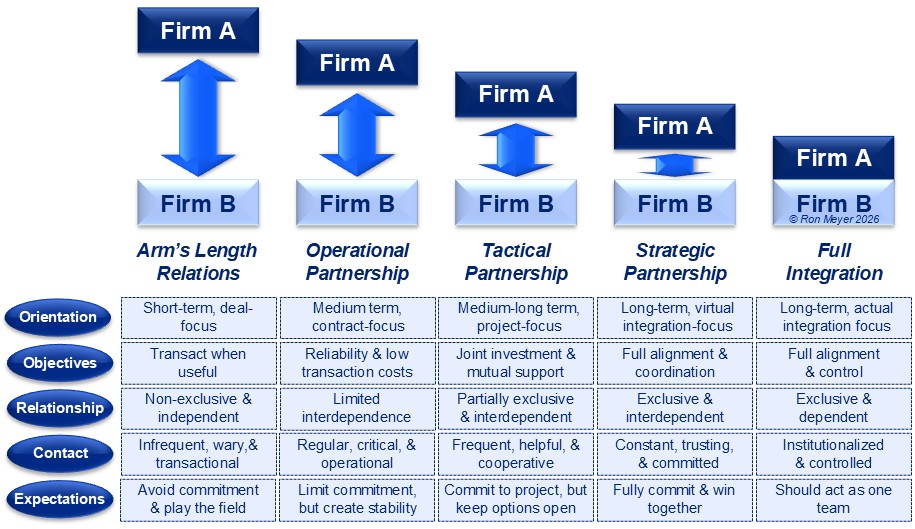
The Organizational Partnering Model is a framework outlining three types of partnering, between the two opposite poles of arm’s length relations and full integration. Distinguishing these three is important as partnering is often seen as only one option instead of three. In this model, each of the five types of organizational relationships is explained, making it a useful framework to determine the most appropriate way to do business with other organizations.
Key Elements
The five organizational relationship types are the following:
- Arm’s Length Relations. The most common relationship is the transactional one, where organizations buy or sell products and/or services with no strings attached. This approach is most appropriate when transaction costs are low, switching is easy, and there is little need for a stable, reliable relationship. Organizations can then shop around for the best deal, without getting locked into one party and becoming more dependent. The relationship is fundamentally competitive, as conditions are determined based on negotiating power.
- Operational Partnership. Where costs associated with each transaction are higher, switching is more difficult and/or costly, and there is a need for a more stable and reliable relationship, organizations can opt to sign contracts covering multiple transactions over a longer period. Such a framework agreement usually fixes prices and conditions to prevent opportunistic behavior. However, such deals are generally time-limited and non-exclusive to avoid lock-in, while the relationship is still largely competitive and negotiated.
- Tactical Partnership. Where parties need to jointly invest and support each other to realize a specific common goal, their relationship will need to be tighter, more trusting and long-term. As switching will be more difficult, they will need to be more committed to the joint venture, but at the same time both will want to keep their options open and not become too dependent on the other. Such a relationship is a tactical halfway house between cooperation (winning together) and competition (winning at the expense of the other).
- Strategic Partnership. Where both sides become indispensable to each other – either winning together or losing together – they often choose to fully commit to a long-term mutually beneficial relationship. Not only does this require aligning their operations, but they will also need to coordinate their strategies, thereby moving towards virtual integration. This level of cooperation demands a high level of commitment, trust and reciprocal support, which usually can only be maintained in an exclusive or nearly exclusive relationship.
- Full Integration. When the level of dependence on each other is high, it can leave one or both sides feeling vulnerable to the other’s underperformance, or even worse, to potential misalignment, conflict and/or self-serving behavior. As partnering is based on voluntary cooperation, the exposed side can feel they have limited power to influence the other side’s behavior. Therefore, they often prefer to take ownership of the other, so they have formal control and can integrate them into the governance structure, thus “enforcing cooperation”.
Key Insights
- Partnering is found between bachelorship and marriage. Like committed bachelors, organizations can play the field, while keeping suitors at arm’s length and remaining independent, or they can tie the knot, committing to integrating their lives for the long run. Yet, between these two opposites, there is the possibility to build a partnership, balancing the need for self-determination and autonomy with the need for cooperation and stability.
- Partnering comes in three forms. An operational partnership is a loose form of cooperation, focused on medium-term stability and predictability, almost like dating. A tactical partnership is a tighter form of cooperation around an important joint interest, almost like living apart together. A strategic partnership is a very tight form of cooperation, focused on long-term integration, like living together but without getting formally married.
- Partnering balances competition & cooperation. Organizations need to be competitive – focused on winning themselves even when it is at the expense of others. Yet they also need to be cooperative – focused on working with others to win together even when it might be at their own expense. The three partnering forms find a different balance between both.
- Partnering is harder than the extremes. The invisible hand of the market (arm’s length relations) and the visible hand of management (integration) are easier than the continuous handshake, which requires mutual understanding, trust and ongoing coordination.
- Partnering is a strategic choice. For each organizational relationship in the value chain, all five alternative forms of doing business with each other need to be considered.
84. Feedback Flavors Framework
Key Definitions
In cybernetics (the study of control systems), feedforward is the initial assignment given to a system or person to direct its behavior, while feedback is the information looped back to that system/person with the goal of correcting or confirming its course of action. In other words, the purpose of feedback is to steer the other in the intended direction.
Unfortunately, in common usage, “feedback” has come to mean any type of comment that people make to someone else. “Can I give you some feedback?” is usually followed by an assessment, complaint, frustration and/or verdict. However, expressing a judgment without the intention of steering the other’s behavior isn’t feedback, but merely stating one’s opinion.
Conceptual Model
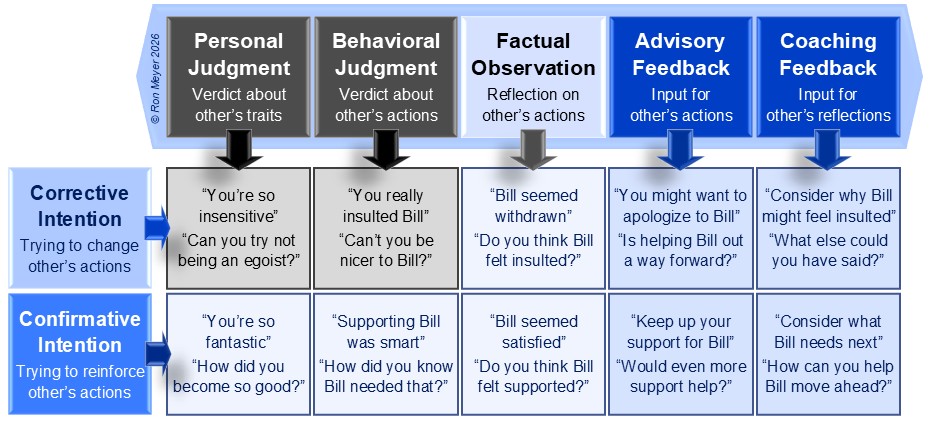
The Feedback Flavors Framework is a model outlining ten categories of responses that people can give to the behavior of others, of which four “flavors” qualify as highly effective feedback and four as moderately impactful. The main purpose of the model is to help distinguish between judgment and effective feedback. A response is a judgment if it is intended to convey the sender’s evaluation. It is only effective feedback if the response is tailored to influence the receiver’s behavior. Stated simply, judgment is “what I would like to say”, while feedback is “what the other needs to hear”. So, giving effective feedback requires the sender to move beyond merely expressing an opinion, to consider how to get the receiver to move in a particular direction. The framework then suggests four highly effective feedback flavors (in darker blue) and four moderately effective ones (in lighter blue). Two are usually ineffective.
Key Elements
The two opposite reasons for wanting to give feedback (on the vertical axis) are:
- Corrective Intention. Feedback is often used to correct course and get the receiver back on the right track. It focuses on what is missing or wrong and is directed at closing the gap.
- Confirmative Intention. Feedback can also be used to confirm the course and encourage the receiver to stay on track. It acknowledges what is going well and can be built on.
The five main categories of responses (along the horizontal axis) are the following:
- Personal Judgment. Feedback can be directed at the personality of the receiver, which is nothing short of a verdict about their character. When positive, such feedback can help the receiver to feel appreciated, but if the feedback is critical, the receiver will likely feel personally rejected or even attacked, which rarely gets them to adapt their behavior.
- Behavioral Judgment. Instead of judging the person, feedback can be focused on judging their actions. When positive, such feedback can help the receiver to feel recognized, but if the feedback is critical, the receiver will likely take it as a complaint or a difference of opinion, which typically leads to a defensive reaction, not necessarily adapted behavior.
- Factual Observation. A more neutral form of feedback is where someone shares what they objectively see. This can make receivers more aware of the situation, nudging them to adapt or continue their behavior. But it can also reveal that both sides have a different perception of the facts, which can be a good start to even more effective forms of feedback.
- Advisory Feedback. Instead of immediately expressing their judgment, feedback givers can transform their assessment into forward-looking suggestions. Such feedback can be useful advice on how to improve or further build on the receiver’s behavior. Key for achieving acceptance is that receivers feel they are being helped, not berated.
- Coaching Feedback. Often, even more helpful than getting advice is being coached to come up with successful next steps yourself. This coaching can be in the form of questions or statements, intended to trigger a line of reasoning in receivers, so they formulate their own improvements or find their own ways to build on the current strengths.
Key Insights
- Effective feedback is receiver-oriented. We all judge others but voicing that opinion is not feedback. Sharing your views, or getting things off your chest, is not feedback. Feedback is the act of looping a signal back at a receiver with the intention of influencing their behavior. Feedback is only effective if it triggers a reaction. As with communication, it’s only effective if the message is packaged in a way that receivers will understand.
- Effective feedback avoids defensive mechanisms. No one likes being judged, even when feedback is called “a gift”. Judgmental comments feel like an attack, even when they’re sugar-coated, and provoke a defensive response. Therefore, effective feedback avoids judgment but instead is helpful – it doesn’t condemn but is constructive. It isn’t about pointing out what is wrong but helping to find out how things could be made better.
- Effective feedback can be corrective or confirmative. Effective feedback givers want to steer the behavior of feedback receivers (see Meyer’s Management Models #55, Duty of Care Model). This steering can be directed at getting receivers back on course (corrective feedback) or getting them to continue on course (confirmative feedback).
- Effective feedback comes in eight flavors. Of the ten categories of feedback, two are hardly ever effective (in gray), because of their critical judgmental nature. Four types of feedback can have a moderately effective impact (in light blue), while four others (in darker blue) can be much more impactful, because they use helpful advice or coaching as means.
- Effective feedback requires effort from the giver. Blurting out your opinion is easy. Calling your complaints “feedback” so the other is forced to listen is lazy. Effective feedback is hard, because it forces givers to think hard about how to trigger change in the receiver.
83. Humanistic Organization
Key Definitions
Organizations are groups of people working together to achieve a shared goal. To realize their common objective, they split the required tasks amongst one another and then cooperate to align their activities. This division and subsequent coordination of labor makes specialization possible, leading to increased expertise (higher quality) and economies-of-scale (lower cost).
There are many types of organizations, but a more limited number of organizational paradigms – lenses through which we understand what organizations are and how they function. For centuries, the most dominant paradigm has been to see organizations as a type of machine, with people as human resources slotted into the machine (mechanistic organization paradigm).
Conceptual Model
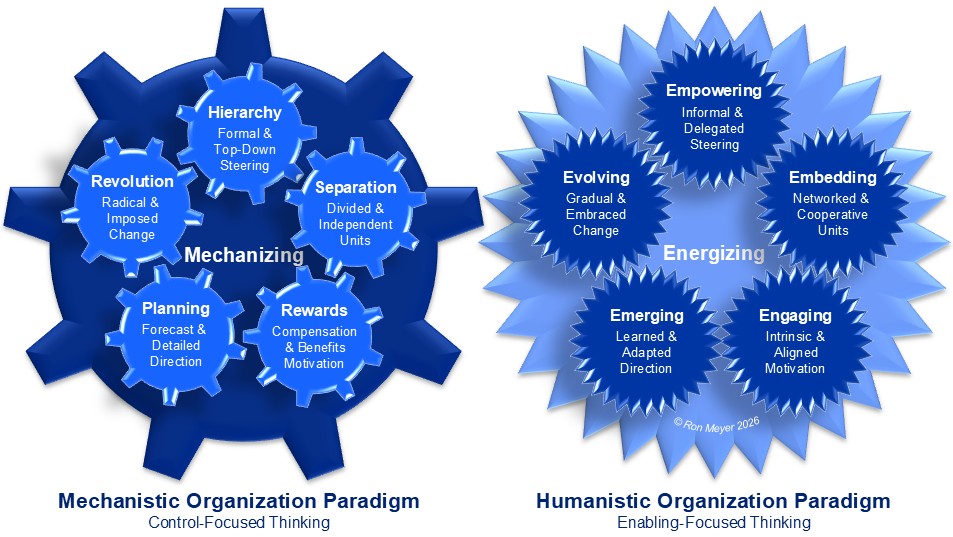
The Humanistic Organization Paradigm is a cognitive framework for understanding what organizations are and how they function. To clarify its fundamental tenets, the figure below contrasts the humanistic perspective with the core assumptions underpinning the mechanistic organization paradigm. While the latter sees people as human resources that can be employed to enable the machine to work more effectively, the humanistic organization paradigm sees organizations as arrangements that enable people to work more effectively. The mechanistic approach is focused on controlling everything, including people, while the humanistic approach aims at enabling people. Using this paradigm more consistently can have a far-reaching impact on how people organize, while as a practical tool it can be used as checklist to search for ways to energize people and improve organizational effectiveness.
Key Elements
The five main differences between the paradigms are the following:
- From Hierarchy to Empowering. Instead of using a formalized power structure to steer the organization top-down, the humanistic paradigm emphasizes more ownership, responsibility and decision-making in the hands of the doers, guided by leaders nudging people in the right direction using their informal authority. This results in organizations that are flatter, with managers who do not control and coerce, but facilitate and encourage.
- From Separation to Embedding. Instead of splitting tasks and then keeping them in independent silos (all division and little coordination of labor), the humanistic paradigm emphasizes coordinative networking between individuals, teams, units and even organizations, with the intention to cooperate and link up. This results in organizations that are collaborative ecosystems, with people preferring long-term over transactional relations.
- From Rewards to Engaging. Instead of using compensation and benefits to motivate people to perform, the humanistic paradigm emphasizes triggering people’s intrinsic motivation, by appealing to their need for purpose, meaning, direction, contribution, community and safety. This results in organizations with high team spirit, with people who have committed their hearts and minds, instead of only responding to carrots and sticks.
- From Planning to Emerging. Instead of predicting the future and drawing up a detailed roadmap of how to get there, the humanistic paradigm emphasizes the need to embrace volatility, uncertainty, complexity and ambiguity, by getting people to guestimate, try, reflect and course correct. This results in organizations that are resilient and agile, that is, robust and able to flexibly respond to unfolding circumstances, instead of fragile and rigid.
- From Revolution to Evolving. Instead of pushing through large and widespread changes within a short time span on to reluctant people, the humanistic paradigm emphasizes the need to gradually and continuously change, giving people time to let go, embrace, learn and adjust, with leaders as sherpas guiding people on their adventure. This results in organizations that are adaptive, with change not being done to people, but with
Key Insights
- The humanistic organization paradigm is a lens. Paradigms are cognitive filters through which we view the world. They are not true or false, but color our understanding of reality. The mechanistic organization paradigm has been around for centuries, even before it became mainstream starting with Taylor in the early twentieth century. But more human-focused thinking is also not new, going back to Mayo in the 1930s (human relations theory).
- The humanistic organization paradigm is human-centric. While the mechanistic paradigm sees organizations as a type of machine running on human resources, the humanistic paradigm sees organizations as collections of humans working together in particular ways – people don’t work at an organization, they are the organization.
- The humanistic organization paradigm emphasizes enabling. Machine-thinking is about controlling – determining the future and what people do. It is based on the power to predict and command, while the compliance of people must be forced or bought. Human-centered thinking is about enabling – facilitating people to take responsibility and act. It is based on the informal power to nudge and guide, while people’s commitment must be won.
- The humanistic organization paradigm has five distinctive characteristics. People can be enabled and energized by empowering them, embedding them, and engaging them, while also involving them in the emerging direction and the evolving organization.
- The humanistic organization paradigm can also be used as a checklist. While this paradigm can be adopted as organizational philosophy, it can also be used as an inspirational checklist to consider different ways of getting people to work more effectively.
Key Definitions
An organization’s resources are all the means at its disposal that can be used to carry out value-adding activities and create value propositions. Note that people are not resources, but the carriers of resources, such as knowledge, skills and relationships (just as a CD is not music, but a music carrier). Unfortunately, the term human resources is an enduring misnomer.
Following Barney (1991), we define strategic resources as those that meet the VRIO criteria: they are valuable (important for running the business), rare (not widely available to rivals), inimitable (difficult to copy or substitute) and organized (readily available to the business).
Conceptual Model
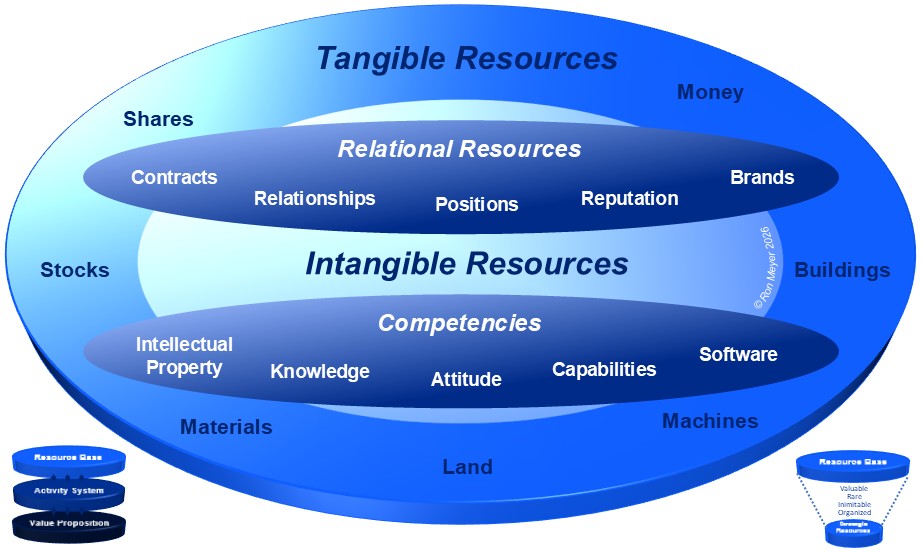
The Resource Base Dial is a framework for mapping all the resources available to (or needed by) an organization to run its business system (see model #32, Strategic Alignment Model). Importantly, this framework looks beyond the tangible resources on an organization’s balance sheet, to identify additional intangible resources – their competencies and relational resources. Once an inventory of all resources has taken place, this can be checked against the resources needed to run the business system, so deficiencies can be spotted (see insert at bottom left) and an analysis can be made of which resources qualify as strategic, so further resource-based strategy development can build on these (see insert at bottom right).
Key Elements
The two main categories of resources are the following:
- Tangible Resources. This is all the stuff that organizations need to function, varying from office buildings to coffee machines, to the money to buy new coffee. Tangible resources tend to be things “you can drop on your foot”, but cryptocurrencies and data are also tangible, as they can be isolated, counted and traded. Sometimes tangible resources are strategic, such as a custom-made production robot or the building housing a hotel, but most tangible resources can be easily acquired or copied, making them non-strategic. As rule of thumb, bookkeepers count what strategically doesn’t count.
- Intangible Resources. These are all the resources that can’t be seen, can’t be bought or sold but need to be gradually developed. They are embedded in the people and the organization in which they have grown, making them difficult to copy and almost impossible to transfer. There are two distinct categories of intangible resources:
- Relational Resources. These are all means that are based on connections between individuals or organizations. Once relationships have been built up, they have the potential to be used to influence others to behave in a particular way. Even where people don’t know each other, but know of each other, that reputation can be leveraged to get things done. In the same way, positions in associations, boards and informal groups can be used to exert influence. Note that these intangibles can sometimes gradually become more tangible, such as relationships being formalized into contracts and reputations being linked to tangible brands. In this way, some football players’ contracts and the team’s brand can even make it onto the balance sheet.
- Competencies. While relational resources are about influence, competencies are about ability – the potential to get things done. It is often said that to act effectively, people and/or organizations need to combine the right knowledge (insight/intelligence) with the right attitude (mindset/philosophy), so they can develop practical capabilities (skills/knowhow). These competencies are learnt and embedded over time, sometimes by separate individuals, but often by cooperating teams of people, often establishing systems and processes to ensure the learning sticks. Note that here too intangibles can gradually become more tangible, as ways-of-working are hardwired into procedures and software, while knowledge is captured in wikis or even as intellectual property.
Key Insights
- The resource base is a key part of the business system. Every business system is a simple input-output function, with resources going in to run various activities, resulting in a value proposition coming out. To optimize this economic value creation system, an overview is needed of the required and available resources (see model at bottom left).
- The resource base consists of tangible and intangible resources. Organizations need hordes of resources to function. These can be tangible (means that can be separated, counted and traded) or intangible (embedded in the organization and developed over time).
- The resource base includes relational resources and competencies. Intangible resources can be divided into two subcategories: relational resources that give individuals or the organization influence, and competencies that give them the potential to perform.
- The resource base can be the basis of strategy. The resource-based view of the firm suggests that sustainable competitive advantage can be derived from leveraging resources that are strategic - that are valuable, rare, inimitable and organized (VRIO). Therefore, identifying, improving and protecting these strategic resources is a crucial strategic action.
- The resource base is a strategic stepchild. In practice, few organizations put emphasis on understanding their resource base and most fail to uncover their strategic resources. The Resource Base Dial offers a simple starting point to identify all existing resources and then to zero in on the strategic resources that could be leveraged (see model bottom right).
Key Definitions
Each person is a complex system of interconnected parts, that defies a simple division into independent building blocks. Still, it can be analytically useful to unravel people into a few key elements, to understand which parts are more susceptible to development than others.
For centuries, philosophers, scientists and amateur psychologists have debated whether people are largely shaped by nature (genes) or nurture (learning), and to what extent their characteristics are stable or can change over time. However, it is safe to say that at least some aspects of a personal system have been learnt and can be developed further moving forward.
Conceptual Model
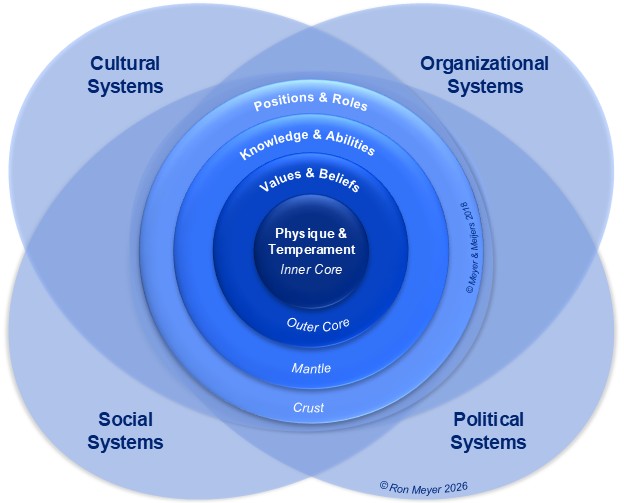
The Personal System Map is an analytical framework (building on Meyer & Meijers, 2018) for understanding which elements make up who a person is, and which will be easier to develop over time. Using the metaphor of a planet, the model suggests that each person consists of four layers, with each deeper one being less adaptable. At the same time, each person is embedded in four external systems that, as four linked types of atmosphere, influence the planet from the outside-in. The message is that people are partially shaped by the systems (also called institutions) they operate in and that the most effective way to develop is to also change from the outside-in – changing positions and roles first and then working inwards.
Key Elements
The four layers making up each individual are the following:
- Physique & Temperament. Each person’s most stable aspect is their physical body (their hardware) and their fundamental personality traits (their operating system). They might gain some weight, but they won’t get taller, while their “big five personality traits” can shift a bit over the years, but not change radically. Both are strongly influenced by genes.
- Values & Beliefs. On this operating system people run a few basic programs that define what to them is of importance (their values) and what is obviously true (their beliefs). These principles form the cognitive filter through which they perceive the world. While rooted in their temperament, both were shaped, and can still be influenced, by external factors.
- Knowledge & Abilities. On top of the basic programs, they collect a lot of information and insights, both articulated and tacit (their knowledge), while also developing app-like skills and routines that allow them to act (their abilities). These are easier to learn, influenced by external factors, but need to fit within the frame of a person’s underlying values and beliefs.
- Positions & Roles. Using one’s knowledge and abilities, a person can fulfill formal positions in organizations and play informal roles in a variety of external systems. This is the easiest aspect of a person to change, as one can switch jobs (“I was a manager, now I’m a professor”) and/or pick up new roles (“I’m now a stepfather”).
Positions and roles are part of a personal system (you are your position/role), but at the same time they are also part of one of these external systems:
- Cultural Systems. A person can belong to various groups who share unwritten behavioral norms, based on common values and beliefs, and expressed in shared customs, symbols and stories. You can be part of a national, professional or even pop culture (“I’m a Swiftie”).
- Organizational Systems. A person can belong to various organizations, which are people structurally cooperating to achieve joint goals. You can work at a business or non-profit organization, but you can also be a member of a sports club or church (“I’m a Catholic”).
- Political Systems. A person can also belong to a web of stakeholders, each with their own power and interests, who interact with each other to decide on important issues. You can participate in governmental politics, but also in networks and associations (“I’m a lobbyist”).
- Social Systems. A person can also belong to various social groups, that share a sense of relatedness, closeness, attachment and loyalty, such as families, clans, tribes, fraternities and communities (“I’m a Meyer”).
Key Insights
- People consist of four levels. Each person can be understood as made up of four levels: an inner core of physique and temperament (“I am tall and extrovert”), an outer core of values and beliefs (“I am liberal and democratic”), a mantel of knowledge and abilities (“I am a chess player”) and a crust of positions and roles (“I am a teacher and husband”).
- People are embedded in four external systems. Each person’s positions and roles are part of four overlapping external types of systems: cultural, organizational, political and social systems. People can be embedded in hundreds of different systems.
- People are shaped through nature and nurture. From birth, people develop from the inside-out based on their physique and temperament (nature) and simultaneously from the outside-in, based on the positions and roles that they take (nurture). The result is a mix.
- People are difficult to change on the inside. As people mature, the deeper layers become gradually more fixed. Their physique and temperament were already hardly changeable, but increasingly their values and beliefs become engrained, while their knowledge and abilities become entrenched and more difficult to adapt or expand.
- People can develop best from the outside-in. By changing positions and roles, people often find it easier to acquire new knowledge and abilities, and even shift/broaden their values and beliefs. Hence, personal development often works best from the outside-in.
80. Five Company-Centric Forces
Key Definitions
When it comes to their culture and behaviors, organizations can be more outward-oriented, focused on responding to the demands in their external environment, or more inward-oriented, concentrated on dealing with the complexities of their internal environment.
For companies, the ultimate form of outward-orientation is customer-centricity – placing the external customer at the center of everything done internally. The opposite can be called company-centricity, whereby people in the organization pay little attention to the outside world but direct their time and energy at coping with internal processes, interests and interactions.
Conceptual Model
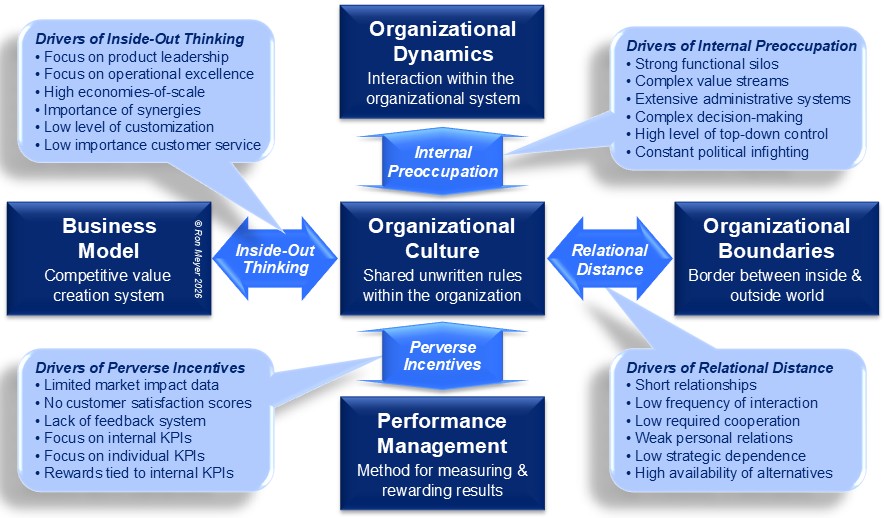
The Five Company-Centric Forces model is an analytical framework for understanding the factors pushing organizations towards inward-orientation. This model is an explicit homage to Porter’s Five Competitive Forces model (1979), that outlined the five external challenges that companies need to contend with to be successful. The Five Company-Centric Forces model outlines the five internal challenges facing companies that draw them towards self-involved inward-orientation, thereby undermining these organizations’ focus on competing externally. The model can be used to uncover the specific drivers of company-centricity in an organization, as a first diagnostic step before taking initiatives to enhance outward-orientation.
Key Elements
The five company-centric forces are the following:
- Organizational Culture. At the center of the model is an inward-oriented culture, that values organizational, departmental or even individual views and interests above those of the customer. Like an ego-centric person, company-centric people believe their worldview is the correct one and they know what good looks like. Dealing with each other is also seen as more important than dealing with customers. Once this culture of self-involvement takes root, it becomes self-perpetuating and can be further strengthened by the other four forces.
- Business Model. The type of business model chosen can influence how much outward-orientation people believe is necessary. Companies competing on personalization and customer service need to think outside-in, while competing on product leadership, operational excellence, economies-of-scale and capturing synergies push people to think inside-out and concentrate on internal processes. The more the inside-out thinkers capture attention and can claim success, the more a culture is nudged towards inward-orientation.
- Organizational Boundaries. Companies often create strong organizational boundaries by keeping their distance from customers. They interact and cooperate infrequently, and avoid personal and long-term relationships, either because they don’t want to, or don’t have to. Keeping customers at arm’s length is generally easier where dependency on customers is low and there are plenty of alternatives. Yet, distance invariably leads to less understanding of, and interest in, customers, thereby reinforcing an inward-oriented culture.
- Organizational Dynamics. Companies can also become intensely preoccupied with their own processes and procedures, which shows up in extensive meeting schedules and reporting systems. Strong silos are by nature inward-oriented, but if they need to coordinate because of complex value streams, procedures and meetings proliferate. Self-involvement is further strengthened by complicated decision-making, political games and top-down controls. When employees are busy with each other, they’re not busy with the customer.
- Performance Management. Finally, companies often measure and reward the wrong type of results. Instead of tracking market impact data and customer satisfaction feedback, companies often use internal performance indicators, typically at the level of a department or individual, encouraging employees to shortsightedly focus on their own work. Where recognition and rewards are linked to these internal, instead of external, results, a perverse incentive is given to become even more inward-oriented and ignore customer satisfaction.
Key Insights
- Company-centricity is extensive inward-orientation. Organizations, like people, find it much easier to understand and be busy with themselves, instead of with others. This inward-orientation, as opposed to outward-orientation, comes in various shades of grey, with at its extreme a far-reaching form of self-involvement called company-centricity.
- Company-centricity is at its heart cultural. Company-centricity is a mindset common to people in an organization, leading to typical behaviors and ways of working. In other words, company-centricity is cultural – unwritten norms based on shared values and beliefs.
- Company-centricity is driven by five forces. A company-centric culture is self-perpetuating and can be reinforced by four other factors: A business model that emphasizes the importance of inside-out thinking, strict organizational boundaries that lead to relational distance, complex organizational dynamics that trigger internal preoccupation and a performance management approach that creates perverse incentives.
- Company-centricity grows over time, if unchecked. These five company-centric forces drive a vicious cycle, gradually decreasing awareness of, and interest in, customers.
- Company-centricity needs to be understood to be countered. The Five Company-Centric Forces model is an analytical framework for understanding the factors causing company-centricity, thereby suggesting places to start building more customer-centricity.
79. Strategic Assignment Matrix
Key Definitions
A corporation has a portfolio of business units when it consists of two or more operating companies, each requiring a separate strategy because they compete in different markets.
While each business unit will typically strive to have a unique competitive strategy, the corporate center will give them a more general strategic assignment to grow, consolidate, turnaround or leave. Corporate investment in each business unit, and the expected future performance, will all be aligned with this specific strategic assignment.
Conceptual Model
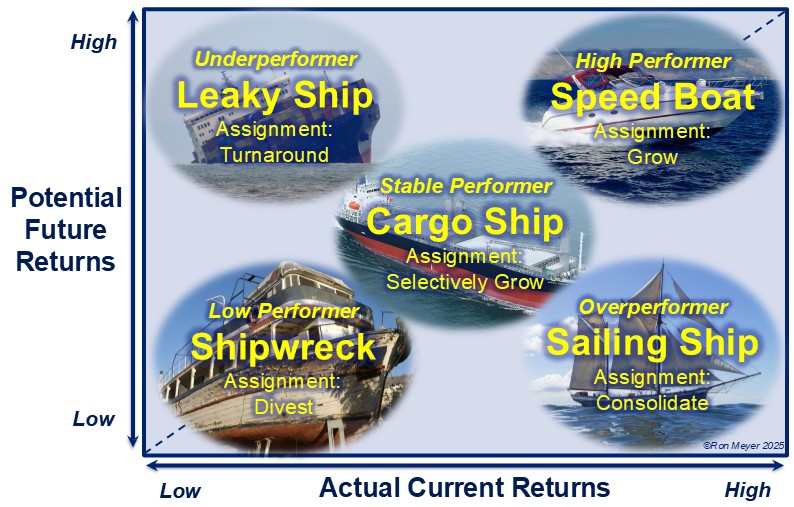
The Strategic Assignment Matrix is an analytical framework for setting the overall strategic objective for each business unit in a corporate portfolio. It is based on a comparison between the current returns achieved by each unit and their potential future performance. The current performance, however measured, is known for each unit, allowing each to be plotted on the horizontal axis, with the expected average return in the middle. Then an analysis of each unit’s potential future performance needs to be made, based on a projection of market attractiveness and the unit’s competitive strength. The resulting position on the vertical axis is both an analytical estimation and a tangible future target. The outcome for each unit will be one of five strategic assignments, with linked room for investment. Ideally, the analysis and conclusions should be jointly agreed on by the corporate center and business units.
Key Elements
The five possible strategic assignments are the following:
- Grow: For High Performing Speedboats. Any business unit that is currently reaching above average returns and has a realistic possibility to keep on achieving superior performance in the coming years, has earned the right, but also has the duty, to invest in further growth. Their assignment will be to realize their potential, by increasing their topline and/or margins in a way that is sustainable in the longer run.
- Selectively Grow: For Stable Performing Cargo Ships. Business units with healthy returns and the prospect of staying that way for the foreseeable future, need to selectively bet on growth opportunities, while keeping their base business stable and up to date. Their assignment will be to stay in shape, by prudently investing in improvements and renewal, to keep their returns on par.
- Turnaround: For Underperforming Leaky Ships. Achieving lower than average returns is a clear indication that the business unit has sprung a leak. It can be an old vessel that hasn’t been properly maintained, or a new one with some start-up challenges. If the future potential is still positive, investments should be made to rapidly turn the situation around. The assignment will be to quickly plug the leak and prove the ship is still seaworthy.
- Divest: For Low Performing Shipwrecks. If the future potential of a poorly performing business unit is unattractive, then investing to plug leaks will not suddenly make a shipwreck seaworthy. Valiantly investing in a sinking ship will only suck the captain down with it. The assignment will be to decisively withdraw from the business, often by divesting it to another shipyard or even by dismantling it, to salvage some reusable parts.
- Consolidate: For Overperforming Sailing Ships. Some business units are like old sailing ships; they’re still operating well, but they’re not the ships of the future. As their longer-term potential is limited, selective investments should be focused on maintenance and sustaining the existing business. Their assignment will be to prolong their lifespan, getting as much mileage out of the existing resources and relations as possible.
Key Insights
- Strategic assignments are about future investments. In a corporation with two or more business units, the corporate center must decide like a financial investor in which parts of the portfolio to inject capital, which to hold and which to divest. But while an outside investor can only passively allocate capital, the corporate center can actively assign units the objective to grow, consolidate or exit the business.
- Strategic assignments depend on current and future performance. When determining which assignment to give each unit, the corporate center will contrast how well each unit is currently performing, which is known, with its future performance potential, which needs to be analyzed by considering the future market attractiveness and the unit’s potential competitive position. Current and future performance potential are plotted in the matrix.
- Strategic assignments come in five flavors. The five generic strategic assignments are grow, selectively grow, turnaround, divest and consolidate. Each assignment provides a business unit with the general direction on which to base their detailed business strategy.
- Strategic assignments need to be managed differently. While each business unit needs to tailor its strategy to fit its strategic assignment, the corporate center will need to manage the various categories of business units differently. Especially the businesses with a turnaround and divest assignment might require a separate approach and/or team.
- The Strategic Assignment Matrix is a complementary portfolio analysis tool. Most other portfolio analysis tools, such as the BCG Matrix and GE Business Screen, map each unit’s future potential, but don’t suggest a strategic assignment. The Strategic Assignment Matrix is a complementary tool that can best be used after a first portfolio analysis to agree on the strategic assignment that each unit will be given.